Maybe your partner hears the sound at night. Maybe you wake up with a sore jaw or a dull headache near your temples.
Either way, grinding your teeth is more common than you might think, and it matters a lot if you have dental implants or plan to get them.
You can absolutely get dental implants if you grind your teeth, but you will need a custom night guard, careful bite adjustment, and sometimes stronger crown materials to protect your investment.
The reason is simple: grinding puts extra pressure on your implants, and unlike natural teeth, implants don’t have the tiny ligaments that help absorb that force.
Bruxism is the medical term for clenching or grinding, and it can happen while you’re awake or while you sleep.
Sleep bruxism is a movement disorder tied to your sleep cycle, and many people have no idea they’re doing it until a dentist spots worn enamel or cracked teeth.
This guide walks you through the warning signs, how implant planning changes when you grind, and why a custom mouth guard is usually part of the plan.
Key Takeaways
- Grinding adds force to implants, which can loosen parts or crack crowns over time.
- Sore jaws, morning headaches, and worn teeth are common clues that you clench at night.
- A custom night guard, a well-adjusted bite, and managing stress help your implants last.
How Bruxism Changes Implant Risk
Grinding puts pressure on your implant that your body can’t cushion the way it cushions a natural tooth.
That extra force shows up in three places: the parts above the gum, the screw holding them together, and the bone wrapped around the implant post.
Why Implants Handle Force Differently Than Natural Teeth
Each of your natural teeth sits in a small sling of tissue called the periodontal ligament. It works like a shock absorber, letting the tooth shift a tiny bit and sending pain signals when you bite too hard.
An implant post has none of that. It fuses straight to your jawbone. While a dental implant improves jaw health by helping maintain stimulation in the surrounding bone, pressure from grinding still moves directly into the bone with no periodontal ligament to cushion it.
You also lose the warning system. Because there’s no ligament, your brain gets less feedback about how hard you’re clenching, so you may grind harder on the implant side without noticing.
For comparison, normal chewing puts roughly 20 to 40 pounds per square inch on a tooth, while grinding can reach 200 to 300 pounds per square inch.
That difference is why bruxism matters so much for dental implant treatment.
Mechanical Problems Caused by Repeated Clenching
Most grinding damage shows up in the prosthetic components, not the implant itself. Here’s what dentists see most often:
- Loose abutment screw, as the small screw joining the crown to the post backs out, and the implant crown feels wobbly
- Chipped or cracked porcelain on the implant restoration
- Fractured crowns that need to be remade
- Flattened, worn chewing surfaces, just like on other dental restorations
- Screw or post fracture in less common cases
These are repairs, not disasters. Still, teeth grinders face about 2.5 times higher risk of implant failure, so catching a loose screw early keeps a small fix from turning into a bigger one.
Bone Stress and the Importance of Osseointegration
The first few months after placement are when your jawbone grows tightly against the implant post. That process is called osseointegration, and it needs the implant to stay still.
Heavy clenching can cause tiny movements in the socket. When that happens, your body may lay down soft fibrous tissue instead of solid bone, which leaves the implant loose.
Grinding can also cause trouble years later. Ongoing overload may lead to gradual bone loss around the implant, which weakens support and raises the chance of implant complications.
That’s why uneven force distribution gets checked at every visit, your dentist adjusts your bite so no single implant takes more pressure than it should.
Worried that teeth grinding could damage your implants? Schedule an evaluation in Chula Vista, CA to check your bite and implant restoration.
Recognizing Nighttime and Daytime Clenching
Most people who grind their teeth have no idea they’re doing it, which is why bruxism often goes unnoticed until an implant loosens or a crown cracks.
Knowing the difference between sleep and awake clenching, plus the signs your dentist looks for, helps you catch problems early.

Sleep Bruxism Versus Awake Bruxism
There are two main patterns, and they behave differently.
Sleep bruxism happens while you’re asleep. It’s considered a sleep-related movement disorder, and the grinding can be loud enough to wake a partner.
People with sleep bruxism are also more likely to snore or have sleep apnea.
Awake bruxism is usually clenching rather than back-and-forth grinding. It often shows up when you’re stressed, focused, or frustrated, think holding your jaw tight while answering emails.
Clenching can be completely silent but still puts heavy force on your teeth, implants, and jaw joints. Some people do both.
Signs Your Dentist May Find During an Exam
During the checkup, your dentist notices things you can’t see in the mirror.
Common findings include:
- Wear facets: Flat, shiny spots on chewing surfaces where enamel has been ground down
- Worn enamel that exposes the softer inner layers of the tooth
- Chipped, fractured, or loose teeth, or cracked fillings and crowns
- Jaw muscles that feel enlarged or tender when pressed
- Clicking or popping in the temporomandibular joint (TMJ)
- Scalloped tongue edges or a ridge of tissue along the inside of your cheek
If you have implants, your dentist will also check for loose abutment screws, chipped porcelain, and bone loss around the implant on X-rays.
Signs of a weak jawbone can affect the support around an implant and may indicate that too much force is being applied.
Symptoms That Should Not Be Ignored
Some bruxism symptoms are easy to brush off, but they’re worth mentioning at your next visit.
Pay attention to:
- Morning headaches, often a dull ache at your temples
- Jaw pain, facial pain, or soreness that’s worse right after waking
- A tight or locked jaw that won’t open or close fully
- Tooth sensitivity or pain with no obvious cavity
- Earache-like pain when your ears are actually healthy
- Poor sleep, or a partner reporting grinding noises
Children can grind too, so let your child’s dentist know if you hear it at night.
The sooner you report these signs, the sooner a nightguard can protect your teeth and implants from further damage.
Planning Implants for a Patient Who Grinds
Grinding doesn’t rule out implants, but it does change how your dentist maps out the whole case.
The plan usually involves measuring how hard you bite, choosing sturdier parts, and then adjusting the bite until pressure spreads evenly.
Evaluating Bite Forces, Bone, and Existing Restorations
Your first visit should include a full dental exam for grinding habits, not just a look at the gap where the tooth is missing.
Your dentist checks for flattened cusps, chipped enamel, cracked fillings, and sore jaw muscles. These signs hint at how much force your implant will face each night.
A CT scan shows the height and thickness of your jawbone. Denser bone in a wider ridge handles heavy chewing loads better than thin bone.
Old dental restorations get reviewed too. A worn crown or a loose bridge next to the implant site can throw off force distribution and needs fixing first.
At Bonita Del Rey Dental Care, our dental team evaluates your bite, jawbone, existing restorations, and grinding patterns before planning dental implant treatment.
Selecting Implant Number, Position, and Crown Materials
Once your dentist knows the load, the design work begins. A few common choices:
- More implants, not fewer. Adding an extra fixture spreads pressure across a wider area instead of concentrating it on one spot.
- Wider and sometimes longer implants. Greater surface contact with bone improves stability during implant surgery and healing.
- Careful implant placement. Angling fixtures so force runs down the long axis reduces side-to-side stress.
- Tougher crown materials. Monolithic zirconia resists cracking better than layered porcelain, which tends to chip under grinding.
- Screw-retained crowns. These come off easily if a repair is needed later.
For full-arch cases, a fixed bridge or an implant-supported denture may be built with a metal framework for extra strength.
Keep in mind that implants lack periodontal ligaments, so they can’t cushion pressure the way natural teeth do. Heavy grinding during healing can also interfere with osseointegration.
Fine-Tuning Occlusion After Restoration
The day your implant crown goes in, your dentist checks the occlusion with thin marking paper and asks you to tap and slide your jaw.
The goal is light contact on the implant and no rubbing during side-to-side movement. Your natural teeth should take the lead.
Expect a follow-up visit for a second bite adjustment on your implant restoration, since your bite settles slightly over the first few weeks.
Your nightguard gets fitted at this stage as well. Wearing it consistently, along with ongoing use of a splint and regular checkups, protects your work while you sleep.
Without that protection, crowns and dentures often show premature wear, which shortens implant longevity.
Why a Custom Night Guard Matters
If you grind or clench at night, a night guard is the simplest way to keep those forces off your implant crown and the parts underneath it.
The right guard fits your bite closely, spreads pressure more evenly, and lasts through months of nightly use.
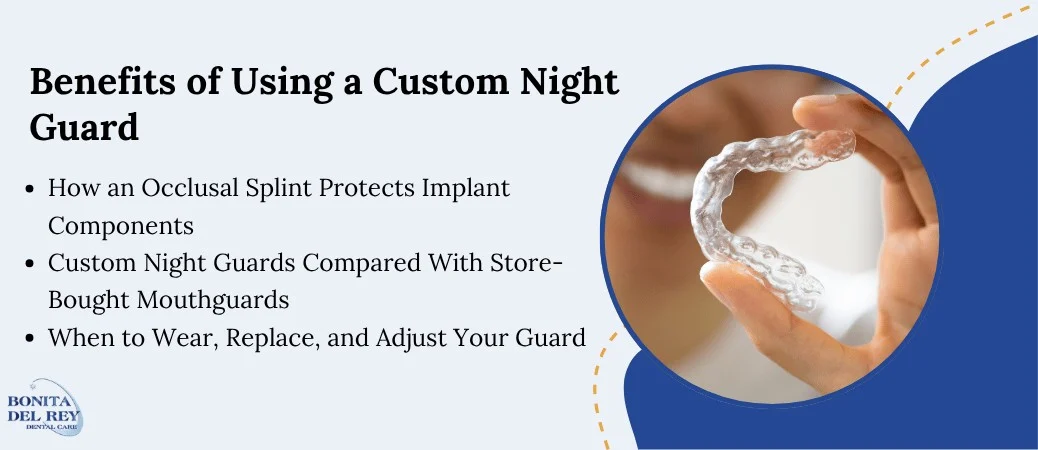
How an Occlusal Splint Protects Implant Components
An occlusal splint is a thin appliance worn over your upper or lower teeth while you sleep. It sits between your arches so your teeth never touch each other directly.
That cushion matters more with implants than with natural teeth. Your natural teeth have a ligament that absorbs some shock, but an implant is fixed straight into bone.
A guard helps with force distribution, which lowers the risk of:
- Chipped or fractured porcelain on implant crowns
- A loose or broken abutment screw
- Cracks in the acrylic of an implant-supported denture
- Wear on the natural teeth that bite against your implant restoration
It also eases the muscle strain that leaves your jaw and temples sore in the morning.
Custom Night Guards Compared With Store-Bought Mouthguards
A drugstore mouthguard is better than nothing, but it is not built for your bite. Boil-and-bite versions often feel bulky and can shift while you sleep.
A custom guard is made from a scan or impression of your teeth, so it is usually more comfortable, stable, and protective than a generic option.
| Feature | Custom guard | Store-bought guard |
| Fit around implant crowns | Adjusted by your dentist | Approximate |
| Material | Hard acrylic, dual-laminate, or soft | Usually soft plastic |
| Typical lifespan | 2–5 years | A few months |
| Bite balancing | Yes | No |
Your dentist can also compare hard acrylic and soft guard options and pick the one that suits how hard you grind.
When to Wear, Replace, and Adjust Your Guard
Wear it every night, plus during naps if you clench in your sleep. Skipping nights gives grinding a chance to loosen screws or chip porcelain.
It is important to bring it to your regular dental checkup. Your dentist checks the fit, looks for thin spots, and rebalances the bite after any new implant restorations or crown work.
A few signs it needs attention:
- Holes, cracks, or worn-through areas
- It feels loose, rocks, or clicks into place
- New soreness in your jaw or teeth
- A smell that stays after cleaning
Rinse it each morning, brush it gently without toothpaste, and let it air-dry in a vented case.
Since grinding is linked to worn enamel and jaw pain, a well-kept guard is easy insurance for the work you paid for.
Managing Triggers and Protecting Your Results
Grinding rarely has one single cause, so protecting your implants usually means working on a few things at once.
Lowering stress, ruling out sleep problems, and staying on a steady care schedule all help your implants last.

Stress, Anxiety, and Daytime Habits
Stress is one of the most common triggers for nighttime grinding, and anxiety, anger, and frustration can all add to the tension in your jaw.
You can’t erase stress, but you can change how your body reacts to it. Relaxation techniques, breathing exercises, and talk therapy such as cognitive behavioral therapy all help some people clench less at night.
A few daily habits are worth a second look, too:
- Caffeine late in the day can keep your sleep light and broken.
- Alcohol before bed often makes grinding episodes worse.
- Smoking tobacco is linked to a higher rate of bruxism.
- Daytime clenching while driving or working carries over into sleep.
Try a simple check-in during the day. If your teeth are touching, let your jaw hang loose with your lips closed.
Sleep and Medical Issues Worth Screening For
Grinding often travels with other sleep issues. If you snore loudly, wake up gasping, or feel tired even after a full night, ask about a sleep study.
Bruxism and obstructive sleep apnea show up together often enough that the pair deserves a real evaluation.
Sleep talking and sleepwalking are also linked to grinding, especially in kids.
Two other things to mention to your dentist:
- GERD (acid reflux): Stomach acid softens enamel, so grinding wears teeth down faster.
- Medications: Some antidepressants (SSRIs), amphetamines, and antipsychotics can increase grinding. Never stop a prescription on your own; talk to your doctor about the dose first.
Treating the underlying problem often does more than treating the jaw alone.
Long-Term Home Care and Dental Follow-Ups
Implants can’t get cavities, but the gum and bone around them can still get sick.
Brush twice a day, clean between your teeth daily, and use whatever tool your dentist recommends for the area around each implant.
Take care of your nightguard as well. Rinse it every morning, brush it gently, let it dry, and bring it to your appointments so your dentist can check it for cracks and thin spots.
Plan on regular checkups so your dentist can watch your bite, the screws, and the crowns. Managing bruxism protects that investment and helps you avoid repeat repairs.
Small fixes now beat big ones later, and steady follow-up is a big part of long-term implant success with grinding.
Frequently Asked Questions
Grinding your teeth at night puts extra force on implants, natural teeth, and your jaw joints, so many people with bruxism end up wearing a custom nightguard.
Below are answers about implant risks, guard types, nightly wear, side effects, and what insurance may pay for.
Can teeth grinding damage dental implants?
Yes. Implants don’t have the shock-absorbing ligament that natural tooth roots have, so grinding forces go straight into the bone around the implant.
Over time, that pressure can loosen the abutment screw, crack or chip the crown, or increase the risk of implant failure.
Grinding during the healing phase is especially risky, because the implant hasn’t fully bonded with the bone yet.
Your natural teeth take a beating too. Dentists often spot bruxism by looking for flattened tooth tips and other signs of wear during a checkup.
Why do I need a nightguard if I grind my teeth while sleeping?
Because you can’t control what your jaw does while you’re asleep. Sleep bruxism is involuntary, and most people don’t know it’s happening until a partner hears the noise or a dentist finds the damage.
A nightguard sits between your upper and lower teeth and acts like a cushion. It spreads out the pressure, so your implant crown, veneers, and enamel don’t take the full hit.
It can also ease jaw muscle soreness and morning headaches. If you have jaw pain, headaches, or new changes in your teeth, it’s worth visiting your dentist.
What is the best type of nightguard for bruxism?
For implants and heavy grinding, a custom guard made from your own impressions is usually the best choice. It fits closely, stays put, and won’t shift and knock into your implant crown.
Here’s a quick comparison:
| Type | Fit | Best for |
| Hard acrylic | Custom, made by a lab | Heavy grinders and people with implants |
| Dual-laminate (hard outside, soft inside) | Custom | Moderate grinding with jaw soreness |
| Soft | Custom or store-bought | Light grinding or clenching |
| Boil-and-bite | Rough, over-the-counter | Short-term use only |
Store-bought guards are cheaper, but they’re bulky and can wear out quickly. Your dentist may also make a custom guard and refer you for stress management or a sleep study if needed.
Is it safe to sleep with a mouthguard every night?
For most people, yes. A well-fitted guard is designed for nightly wear, and consistent use is what protects your implant over the long run.
Keep it clean. Rinse it every morning, brush it gently without toothpaste, and let it air dry before storing it in a vented case.
Bring it to your dental visits so your dentist can check the fit. Guards wear down, and a cracked or thin guard doesn’t protect much.
What are the downsides or side effects of wearing a nightguard?
Most side effects are mild and fade as you get used to it. Common ones include:
- Extra saliva or a dry mouth the first few nights
- Mild tooth or gum soreness in the morning
- Feeling bulky or hard to fall asleep with at first
- Slight jaw tightness while your muscles adjust
A poorly fitting guard can cause real trouble, though. It may shift your bite or put uneven pressure on certain teeth, so call your dentist if the discomfort lasts more than a week or two.
Cutting back on evening caffeine and alcohol, keeping a steady sleep schedule, and using relaxation and jaw stretches can help reduce how often it happens.
Does dental insurance cover a nightguard for teeth grinding?
Many dental plans cover part of the cost, but it varies a lot. Some plans treat it as a basic service, others as a major one.
Watch for a few common rules:
- A documented diagnosis of bruxism from your dentist
- A frequency limit, such as one guard every three to five years
- A waiting period if your plan is new
- Coverage only for custom lab-made guards, not store-bought ones
Ask your dental office to send a pre-treatment estimate before the guard is made. That way, you know your share of the cost up front, and you can compare it to what a damaged implant crown would cost to replace.