A missing tooth affects more than just your smile. It changes how you eat, speak, and feel about yourself.
When you start looking at options to replace missing teeth, you’ll quickly notice that dental implants can cost thousands of dollars per tooth.
That price tag leads many people to search for cheaper alternatives. You might see ads for discount implants at half the usual price or find offers that seem too good to pass up.
Cheap dental implants can end up costing you more in the long run through infections, implant failure, and expensive corrective procedures that exceed what quality care would have cost initially.
The question isn’t whether you can find a lower price, but whether saving money upfront puts your health and wallet at greater risk down the road.
Understanding what drives implant costs helps you spot the difference between a good deal and a dangerous bargain. Lower-quality materials, less experienced providers, and skipped planning steps often hide behind attractive prices.
This breakdown shows you exactly what cheap dental implants risks you’re trading when you choose the cheapest option and how to find safe tooth replacement that fits your budget.
Key Takeaways
- Budget dental implants often use inferior materials and less experienced dentists which increases your risk of failure and complications
- Hidden costs like imaging, bone grafting, and corrective surgeries can make cheap implants more expensive than quality treatment over time
- You can reduce costs safely through financing options, implant-supported dentures, or choosing experienced providers who offer transparent pricing
Table of Content
- What Cheap Dental Implants Actually Include
- Key Cost Factors and Pricing Transparency
- Risks and Trade-Offs of Low-Cost Implant Options
- Comparing Cheap Implants With Alternative Tooth Replacement Options
- Making a Safe, Long-Term, and Cost-Effective Decision
- Frequently Asked Questions
What Cheap Dental Implants Actually Include
Low-cost dental implant offers often cover just one piece of the puzzle, not the complete tooth replacement you might expect.
The advertised price typically includes only the implant post itself, leaving you with high additional costs for the parts that actually give you a functional tooth.
Typical Components and Exclusions
When you see ads for cheap dental implants, the price usually covers just the titanium implant fixture that goes into your jawbone. That’s the foundation, but it’s not a complete tooth.
What’s typically included in budget offers:
- Surgical placement of the implant post
- Basic local anesthesia
- Sometimes a cover screw to protect the implant during healing
What’s usually excluded:
- The abutment that connects your implant to the crown
- The crown itself (the visible tooth part)
- Diagnostic X-rays and CT scans
- Initial consultations and treatment planning
- Sedation options beyond basic numbing
- Tooth extractions if needed
- Bone grafting procedures
Missing components from low-price ads can add thousands to your final bill. A zirconia crown alone typically costs $1,000 to $2,500. The abutment adds another $300 to $700.
Comparing Standard vs. Discount Packages
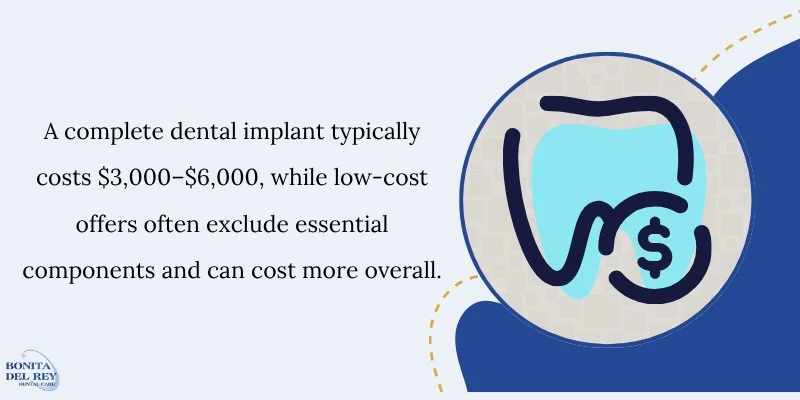
A complete single dental implant from a reputable provider includes everything you need from start to finish. Standard dental implant prices range from $3,000 to $6,000 for the full package.
Standard Package Breakdown:
- Comprehensive diagnostic evaluation with 3D imaging
- Treatment planning and case coordination
- Surgical placement of titanium implants
- Abutment and restoration components
- Provisional temporary teeth when appropriate
- Final crown delivery
- Follow-up care and adjustments
Discount Package Reality:
- Often covers implant fixture only ($999-$1,500)
- Additional procedures billed separately
- May use lower-quality implant systems
- Limited follow-up support
- Total cost can reach $5,000-$7,500 once complete
Mini implants are sometimes offered as cheaper alternatives. They’re smaller and less stable than standard implant systems, making them suitable only for specific situations.
The Truth About Low-Cost Ads
Many low-cost dental implant advertisements use bait-and-switch tactics to get you in the door. Some offers are completely fake, designed by untrustworthy advertisers with no legitimate dental practice behind them.
Once you arrive for your consultation, you’ll often discover you don’t qualify for the advertised rate. Providers may require additional procedures like extractions or bone grafts that weren’t mentioned in the ad.
The materials used in discount implant-supported bridges or full-arch restorations may be lower quality than standard options.
Legitimate providers give you transparent pricing upfront. They explain exactly what your treatment includes and provide a single comprehensive quote.
If an ad lacks a recognizable brand name or provides vague details about what’s included, it’s likely hiding significant costs or cutting corners on quality and safety.
Key Cost Factors and Pricing Transparency
Understanding what drives dental implant prices helps you spot genuinely affordable options versus risky cheap deals. The total cost of dental implants depends on upfront fees, geographic location, and the technology your provider uses.
Upfront and Hidden Fees
Most dental offices advertise a starting price for implants, but the full sequence of components and procedures often costs much more. Your quoted price might cover only the titanium post, while the abutment and crown add $500 to $3,000 extra.
Additional procedures can significantly increase your final bill. Bone grafting typically adds $300 to $3,000 to your treatment cost when you lack sufficient jaw bone density.
A sinus lift costs between $1,500 and $2,500 if your upper jaw needs augmentation before implant placement.
Diagnostic imaging represents another potential hidden expense. CBCT scans and 3D imaging usually cost $200 to $600 but give your oral surgeon crucial information for precise placement.
Some clinics include these scans in bundled pricing, while others charge separately.
Ask about transparent pricing that breaks down every component. Financing options like CareCredit can spread payments over months, but make sure you understand interest rates and terms before signing up.
Geographic and Provider Differences
Urban areas charge higher prices due to increased overhead expenses and higher demand for dental services. You might pay $4,000 to $6,000 per implant in major cities compared to $3,000 to $4,500 in rural regions.
Provider experience also affects pricing. A board-certified oral surgeon with advanced training in guided implant surgery typically charges more than a general dentist.
This expertise often translates to better outcomes and fewer complications.
Different implant systems vary in cost too. Premium brands like Nobel Biocare or Straumann cost more than generic alternatives but offer extensive research backing their long-term success rates.
Your provider’s choice of implant materials matters for both price and durability.
Role of Technology and Materials
Modern dental technology increases initial costs but improves accuracy and reduces complications. Guided implant surgery using 3D imaging costs more upfront but helps your dentist place implants with millimeter precision.
Implant materials significantly impact your final bill. Titanium posts remain the most common choice at standard pricing. Zirconia implants cost 20% to 30% more but offer a metal-free alternative that some patients prefer for aesthetic or health reasons.
Higher-quality implant systems include better warranties and proven track records. Premium materials resist corrosion and integrate with your bone more predictably than bargain alternatives.
Risks and Trade-Offs of Low-Cost Implant Options
Low-cost dental implants often come with higher failure rates, compromised materials, and less experienced providers. The money you save upfront can quickly disappear when complications require additional surgeries or replacements.
Complications and Implant Failure
Poor quality materials used in low-cost implants directly affect how well the implant post integrates with your jawbone.
Osseointegration is the process where titanium fuses to bone, and cheaper implant fixtures may lack the surface treatments that help this happen reliably.
When osseointegration fails, you face implant failure within months or a few years. The implant becomes loose, painful, or falls out completely.
Peri-implantitis is another common problem with cheap dental implants. This infection around the implant site causes inflammation, pain, and progressive bone loss that damages your jaw.
Failed implants need removal, bone grafting to repair the damage, and several months of healing before you can try again. Your implant success rate drops significantly when providers cut corners on materials or surgical planning.
What started as a way to save money becomes far more expensive than choosing quality care from the start.
Common Shortcuts and Their Impact
Discount providers reduce costs by skipping important steps in implant dentistry. Many clinics cut expenses by using lower-priced implant brands, minimal diagnostic imaging, or outsourcing lab work to cheaper facilities.
Without 3D scans before implant surgery, your dentist can’t see nerve locations or measure bone density accurately.
This increases the risk of nerve damage, sinus perforation, or placing the implant in weak bone that won’t support it.
Some cheap offers also exclude proper anesthesia options, abutments, crowns, or follow-ups from the advertised price.
Dental tourism might seem attractive, but you lose access to follow-up care when problems develop. If your implant fails months after returning home, you’ll need to find a local specialist willing to fix someone else’s work.
Importance of Clinical Expertise
Your surgeon’s training directly affects your outcome. Oral surgeons and periodontists complete years of specialized education in implant placement. General dentists offering bargain prices may lack this specific experience.
Experienced providers know how to handle complications during surgery, recognize when bone grafting is needed first, and position implants for the best long-term results.
They also teach you proper oral hygiene techniques and schedule regular follow-ups to catch early warning signs of problems. You need to brush and floss around implants carefully to prevent infections.
Choosing the cheapest option can mean higher complication rates and more rework down the line. A skilled specialist costs more initially but protects your investment for decades.
Comparing Cheap Implants With Alternative Tooth Replacement Options
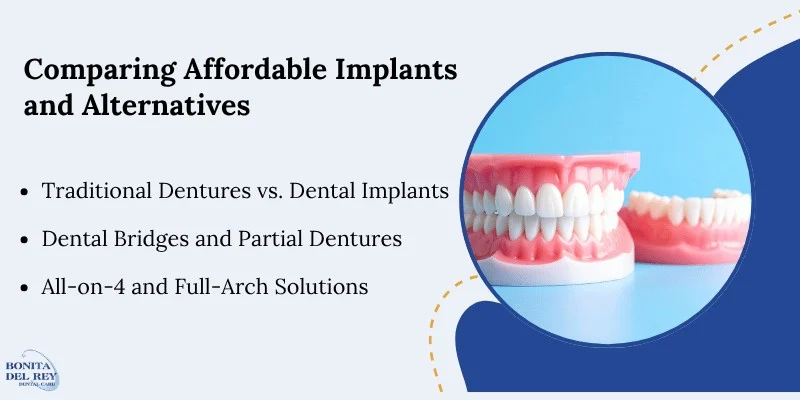
When weighing cheap dental implants against other solutions, you’ll find that traditional options like dentures and bridges often cost less upfront but come with different maintenance needs and longevity.
Each replacement method has distinct advantages depending on your budget, oral health, and how many teeth you need to replace.
Traditional Dentures vs. Dental Implants
Traditional dentures are removable appliances that sit on your gums to replace missing teeth.
They’re typically the most affordable option, with full sets costing between $600 and $3,000 compared to $1,500 to $6,000 for a single tooth implant.
You’ll need to remove dentures daily for cleaning and use adhesives to keep them in place.
Over time, your jawbone can shrink without tooth roots, which means you’ll need a reline every few years to maintain proper fit. This ongoing maintenance adds to the total cost.
Cheap dental implants offer more stability since they fuse to your jawbone like natural tooth roots. You won’t deal with slipping or clicking sounds when eating or speaking.
However, if you’re considering discount implants, they might fail sooner than traditional dentures last, which typically need replacement every 5 to 7 years.
Dental Bridges and Partial Dentures
A dental bridge fills gaps by attaching artificial teeth to your natural teeth on either side. Bridges cost between $2,000 and $5,000 per tooth, making them cheaper than standard implants but more expensive than a partial denture.
Your dentist must grind down healthy teeth to place crowns that support the bridge. This permanent alteration is a major drawback compared to both cheap implants and removable options.
A partial denture clips onto your remaining teeth and costs $300 to $5,000 depending on materials. You can remove it for cleaning, but it’s less stable than fixed options.
An implant-supported bridge combines the best of both worlds by anchoring to implants instead of natural teeth, though this costs more than traditional bridges.
All-on-4 and Full-Arch Solutions
The All-on-4 technique uses just four implants to support a full arch of replacement teeth. This approach costs $15,000 to $30,000 per arch, which is less than placing individual implants for every missing tooth.
Full-arch restoration with All-on-4 gives you fixed teeth that feel more natural than traditional dentures. You won’t need bone grafting in most cases, which reduces both cost and recovery time.
Mini implants are another budget option for stabilizing dentures, ranging from $500 to $1,500 each.
If you’re comparing cheap full-arch implants to quality dentures, consider that failed budget implants might cost more to fix than choosing proven alternatives from the start. Full dentures with proper care can serve you well for years at a fraction of the price.
Making a Safe, Long-Term, and Cost-Effective Decision
Choosing the right dental implant provider involves asking detailed questions about their experience and pricing structure.
You’ll also want to explore payment options that fit your budget while ensuring you can maintain your implants properly for decades to come.
Questions to Ask Your Implant Provider

You need to ask your dentist about their specific experience with implant systems and how many procedures they’ve completed.
Find out what implant materials they use and whether they’re from reputable manufacturers with proven track records.
Request transparent pricing that breaks down each cost component. This should include the surgical placement, abutment, crown, and any necessary follow-ups.
Ask if they offer bundled pricing that combines all these elements into one fee.
You should also inquire about their success rates and complication rates over the past five years.
Ask what happens if the implant fails within the first year and whether any warranty or guarantee covers replacement costs. Don’t hesitate to request references from previous patients who received similar treatments.
Financing and Payment Strategies
Many dental offices work with financing companies like CareCredit that offer payment plans with low or zero interest for qualified patients.
These plans let you spread the cost over 6 to 24 months, making expensive implants more manageable for your monthly budget.
Some providers offer in-house financing options that don’t require credit checks. You might also check if your dental insurance covers any portion of the implant procedure, as more policies now include partial coverage for implants.
Dental tourism can reduce costs significantly, but you need to factor in travel expenses and the difficulty of returning for follow-ups if complications arise.
Compare the total cost including flights and accommodations before deciding if overseas treatment makes financial sense.
Maximizing Implant Longevity
Your implants can last 20 to 30 years or longer when you maintain excellent oral hygiene habits. You must brush and floss daily around the implant crown just as you would with natural teeth to prevent peri-implantitis.
Schedule regular dental checkups every six months so your dentist can monitor the implant and surrounding tissues.
Professional cleanings remove buildup that your regular brushing might miss and help catch potential problems early.
Key maintenance practices include:
- Brushing twice daily with a soft-bristled toothbrush
- Flossing around implants using special floss or interdental brushes
- Avoiding hard foods that could damage the crown
- Quitting smoking to improve osseointegration success
- Attending all scheduled follow-ups during the healing period
The quality of implant materials matters for longevity, so choosing reputable implant systems from the start reduces your risk of premature failure.
Frequently Asked Questions
Dental implant costs can change based on location, experience level, and what’s actually covered in the price.
Understanding the warning signs and knowing what to ask helps you compare options without putting your oral health at risk.
What factors make dental implant prices vary so much between clinics?
Location plays a big role in pricing. Clinics in large cities often charge more due to higher overhead costs like rent and staff salaries.
The dentist’s training and experience also affect the price. Specialists who have completed advanced implant training typically charge more than general dentists.
The quality of materials matters too. Premium implant brands with proven track records cost more than generic or overseas brands with less research behind them.
Technology and facility features add to costs. Clinics with 3D imaging, on-site labs, and modern equipment usually charge higher fees than basic offices.
What risks should I watch out for when an implant quote seems unusually low?
Hidden costs and poor materials often hide behind extremely low prices. You might find out later that the quote only covers the implant post, not the abutment or crown.
Some providers use bait-and-switch tactics to get you in the door. Once you arrive for your consultation, you may discover you’re not eligible for the advertised price or that you need additional procedures.
Lower-quality implant materials can lead to higher failure rates. Cheap implants might not integrate properly with your jawbone, requiring removal and replacement.
Inexperienced providers sometimes offer discount rates to build their practice. This can mean longer procedure times, more complications, and poor long-term results.
How can I tell if a dentist or clinic is qualified to place implants safely?
Check if the dentist has completed specialized training in implant dentistry. This training goes beyond regular dental school and focuses specifically on implant procedures.
Ask about their experience level. Find out how many implants they’ve placed and whether they handle complicated cases or refer them out.
Look for memberships in professional organizations like the American Academy of Implant Dentistry. These groups require ongoing education and adherence to standards.
Read patient reviews and ask to see before-and-after photos. Real patient outcomes give you insight into the quality of work you can expect.
What’s typically included (and not included) in a low-cost implant package?
Many low-cost offers only cover the surgical placement of the implant post. The abutment that connects to your tooth and the crown itself cost extra.
Consultations, X-rays, and CT scans often aren’t included in the advertised price. These diagnostic tools are necessary for safe implant placement.
Sedation or anesthesia usually adds to the final bill. If you need tooth extractions or bone grafting, those procedures come with separate charges.
A comprehensive single-tooth implant typically ranges from $5,000 to $7,500 when you factor in everything. Follow-up visits and adjustments may or may not be covered depending on the clinic’s policy.
Could cheaper implant materials or brands affect durability and long-term results?
Established implant brands invest heavily in research and testing. Their products have decades of clinical data showing high success rates and long-term stability.
Budget or generic brands often lack this extensive testing. They might use different materials or manufacturing processes that haven’t been proven over time.
Some overseas implants cost less but may not meet the same quality standards as US or European brands. If complications arise, replacement parts might be hard to find or incompatible.
Material quality affects how well the implant bonds with your bone. Poor integration can lead to implant failure, infection, and the need for costly repairs or replacements.
What questions should I ask at a consultation to compare implant quotes confidently?
Ask what’s included in the total price. Make sure the quote covers the implant, abutment, crown, imaging, and all necessary appointments.
Find out what implant brand they use and why they recommend it. Ask about the success rates and how long the brand has been on the market.
Question what happens if something goes wrong. Does the clinic offer warranties or guarantees, and what do those actually cover?
Request information about the dentist’s training and experience with implants. Ask how many procedures they perform each month and if they handle complex cases.
Inquire about the treatment timeline and follow-up care. Understanding the full process helps you avoid surprise appointments and additional costs down the road.