Choosing between same-day and traditional implants can be confusing, especially when timing, healing, and long-term success all play an important role.
You can choose same-day implants if you want a fixed tooth quickly and you have good jawbone and healthy gums, while traditional implants give a slower but more tested path that fits more complex cases.
Same-day implants speed up your treatment if your mouth meets the right health requirements, but traditional implants often offer higher predictability for long-term success.
You will want to weigh how fast you need a tooth, whether your bone can support an immediate load, and how comfortable you are with follow-up visits.
This article walks you through the key differences, who usually qualifies, and the trade-offs so you can decide which route fits your life and dental needs.
Key Takeaways
- Choose speed and convenience when your oral health supports immediate placement.
- Prefer the traditional path when you need more predictable long-term results.
- Let bone health and treatment goals guide your final choice.
Understanding Same-Day Implants and Traditional Implants
You will learn the main differences in timing, healing needs, and who each option suits best. Read the short descriptions below to see how each method works and what you can expect during treatment.
What Are Same-Day Implants?
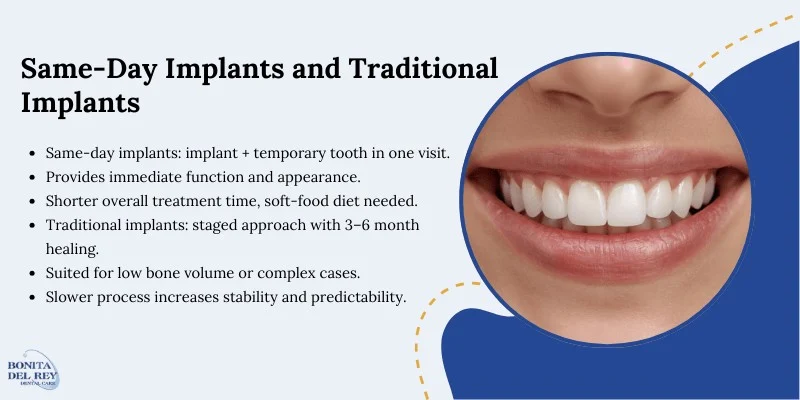
Same-day implants (also called immediate load implants, teeth in a day, or same-day dental implants) let you leave the office with a working tooth the day the implant is placed. Your dentist inserts a titanium implant into your jaw and fits a temporary crown or denture that stays in place while the bone heals.
This immediate restoration gives you function and looks quickly, which matters if you need to eat or speak normally right away.
You need good bone density and healthy gums for this option to be safe. Your dentist will use imaging and precise planning to reduce risk. Expect a shorter overall treatment time, but you’ll still follow a soft-food diet and careful hygiene while osseointegration occurs.
What Are Traditional Implants?
Traditional dental implants (sometimes called conventional implants) use a staged approach. First, the implant post is placed into the jaw. Then you wait 3–6 months for the bone to fuse to the implant (osseointegration). After that, your dentist adds an abutment and a permanent crown.
This method suits patients with lower bone volume, complex bite issues, or the need for bone grafting. The slower timeline can mean fewer immediate load risks and a very stable long-term result. You will attend more visits, but the stepwise healing process often improves predictability for complex cases.
For a clear comparison of immediate and staged options, see differences explained by Northern VA Periodontics.
Comparing Implant Procedures and Timelines
You’ll learn how each approach moves from surgery to a usable tooth, how long healing takes, and what steps matter most for success. Focus on bone health, the type of restoration, and the number of visits you’ll need.
Same-Day Implant Process
Same-day implants, often called immediate implants, let you leave with a temporary crown or fixed temporary bridge the same day the implant post is placed.
Your surgeon places the implant post into the jaw during oral surgery and attaches a temporary prosthetic when primary stability (tightness of the post in bone) is sufficient. This works best if your bone density is strong and you don’t need major bone grafting.
Expect soft-tissue healing in 1–2 weeks and careful eating for several months. The temporary crown protects the site while the implant integrates. After 3–6 months, your clinician replaces the temporary with a permanent crown or final restoration.
Same-day works well for single teeth or select full-arch restorations when planning and imaging show predictable support.
Traditional Implant Process
The traditional implant procedure separates implant placement from crown placement. First, your surgeon may extract a tooth and, if needed, place a bone graft. After that, the implant post is placed into the healed or grafted bone. You’ll wait about 3–6 months for osseointegration, the implant fusing with bone, before the abutment and permanent crown are added.
You might use a removable temporary tooth while healing. This staged approach suits cases with low bone density, complex anatomy, or multiple implants. It lowers load on the implant during critical healing and can improve long-term stability when the bone needs rebuilding.
Implant Placement and Restoration Steps
- Evaluation and planning: 3D imaging and models to check bone, nearby teeth, and nerve positions.
- Tooth extraction (if needed): Immediate implant placement may follow extraction; otherwise, healing time is allowed.
- Implant placement: The implant post (titanium or zirconia) is inserted into the jawbone under local anesthesia.
- Temporary restoration: Same-day gets a fixed temporary crown; traditional often uses a removable temporary.
- Osseointegration: 3–6 months of bone growth around the post; limit chewing force on the site.
- Abutment and permanent crown: After integration, your clinician attaches an abutment and fits the permanent crown or full-arch restoration.
Follow-up visits check healing, oral hygiene, and fit. Your choices depend on bone health, whether you need grafting, and whether you want immediate teeth or can wait for the final restoration.
Not sure which option fits your needs? Explore whether same-day or traditional implants are right for your bone health, healing timeline, and long-term goals.
Candidacy and Suitability
You need enough healthy jawbone, good general health, and realistic expectations to pick the right implant path. Specific dental scans and a clinical exam show whether immediate or staged treatment fits your mouth and lifestyle.
Ideal Candidates for Same-Day Implants
You are a good candidate for same-day implants when you have strong jawbone density and no active gum disease. Good bone quality around the missing tooth lets the implant get primary stability, which helps immediate osseointegration and lowers failure risk.
A CBCT or 3D scan usually confirms bone volume and the absence of infections. If a tooth is extracted, same-day treatment works best when the socket has intact bone walls and minimal bone loss. You should be a non-smoker or willing to stop, since smoking reduces healing and implant stability.
People who want to replace missing teeth quickly and can follow strict aftercare, short rest, soft diet, and hygiene, often benefit. If bone is thin but you still want immediate teeth, some clinics combine limited bone grafting or ridge preservation at the same visit, but that adds complexity and risk.
Ideal Candidates for Traditional Implants
You should consider traditional implants when your jawbone density or bone quality is low. Traditional timing gives bone grafting or sinus lift procedures time to heal before placing implants, which improves final implant stability.
If you have chronic gum disease, active infection, heavy smoking, or poorly controlled diabetes, staged treatment helps manage these issues first. That reduces the chance of implant failure and supports better osseointegration over months.
Traditional implants also suit complex cases where multiple grafts, ridge augmentation, or a sinus lift are necessary to build bone height. This approach delays final crowns until the implant has fully integrated, which can be safer when bone grafting is required.
Factors Impacting Candidacy
Bone density and bone quality in your jaw directly affect whether you can get same-day implants. Low bone density often needs grafting or a sinus lift to create enough support for implant stability.
Your general health matters. Conditions like uncontrolled diabetes or heavy smoking slow healing and can compromise osseointegration. Be ready to share medical history and medications; some medicines affect bone healing.
Dental factors also matter: active infection, the position of adjacent teeth, and bite forces shape the plan. Your ability to follow post-op rules, hygiene, diet limits, and follow-up visits, changes the risk profile. Cost, time off work, and aesthetic goals influence your choice too.
Talk with an experienced implant dentist who will use scans and exams to measure bone, assess need for grafting, and recommend the safest route to replace missing teeth.
Benefits and Drawbacks of Each Option
Same-day implants give you a tooth the day of surgery and cut office visits. Traditional implants spread treatment over months and often handle complex bone or gum issues more safely.
Advantages of Same-Day Implants
You get a working tooth or denture on the day of implant surgery, which helps you restore your smile right away. This is especially useful for front teeth or full-arch restorations where appearance matters.
Fewer visits save time and reduce time off work. You avoid wearing a removable denture during healing when immediate-load implants are used.
When your bone density and gum health are good, same-day loading can preserve gum contours and limit bone shrinkage. Temporary crowns let you test bite and speech before a final prosthesis.
Advantages of Traditional Implants
Traditional implants let bone fuse to the implant before you bite on it, which lowers the chance of implant failure. If you need bone grafting or sinus lifts, staged care gives tissues time to heal.
This approach works for more complex cases, like severe bone loss or active gum disease. You get a stronger long-term foundation for crowns, bridges, or full-arch restorations.
You’ll usually get a final prosthesis made after healing, so the restoration fits precisely. Follow-up visits focus on monitoring osseointegration and preventing peri-implantitis.
Potential Risks and Limitations
Same-day implants carry higher early risk if initial stability is weak; movement under load can cause implant failure. You must follow a soft-food diet and strict care after immediate-load implants.
Traditional implants need more time and appointments. During healing you may use temporary dentures, which can be uncomfortable and affect eating.
Both approaches risk infection, surgical complications, or peri-implantitis if you don’t keep good hygiene. Smoking, uncontrolled diabetes, or poor bone height can limit either option. Talk with your implant surgeon about tests like a 3D scan to check bone and plan surgery.
Visit Bonita Del Rey Dental Care in Chula Vista, CA to learn how modern implant techniques are tailored to your comfort, safety, and long-term results.
Long-Term Outcomes and Care
Same-day and traditional implants can both last many years if you follow good care steps. How well they hold up depends on surgical quality, bone health, and how you clean and check them.
Success Rates and Longevity
You can expect high success rates for both approaches when done by experienced clinicians. Traditional implants often report success rates around the mid-90s percent, while immediate-load or same-day implants typically fall slightly lower but still commonly exceed 90% with proper case selection.
Success depends on osseointegration, the bone fusing tightly to the titanium implant. If osseointegration completes fully, the implant becomes stable and functions like a natural root.
Factors that reduce longevity include low bone volume, smoking, uncontrolled diabetes, and poor oral hygiene. Your dentist may recommend bone grafts or staged procedures when bone is weak to improve chances. Choose a provider who measures bone with 3D imaging and follows proven surgical protocols.
Maintenance and Oral Health
You must brush twice daily and floss or use interdental brushes around implants to limit plaque. Use a low-abrasive toothpaste and a soft-bristled brush to avoid damaging surrounding gum tissue. Schedule professional cleanings every 3–6 months based on your risk level.
Track these signs at home: redness, swelling, bleeding when you clean, or new looseness. Regular check-ups let your dentist test implant stability and X-ray bone levels. If you grind your teeth, ask about a nightguard to prevent overload on crowns and help protect osseointegration during healing.
Managing Complications
Peri-implantitis, infection and bone loss around an implant, is the most serious long-term complication to watch for. Early signs include gum inflammation, bleeding, and increased pocket depth. If you notice these, seek care quickly; early treatment with cleaning, antibiotics, or localized surgery can stop progression.
Loose crowns or implants need prompt evaluation. A crown can often be refitted; a loose implant may need removal if osseointegration fails.
Your provider will review risk factors like smoking or medication use and recommend changes to reduce recurrence. Keep open communication with your clinician and follow their maintenance plan to lower your chances of complications.
Making Your Decision: Choosing the Best Approach
You need a solution that fits your day-to-day life, your wallet, and your mouth. Think about how fast you want results, how much you can spend now, and what your dentist recommends for your bone and gum health.
Lifestyle and Personal Preferences
If you want teeth quickly and your jawbone is healthy, same-day implants give you a finished temporary tooth the same visit. This suits people who work in public-facing jobs, travel often, or cannot manage many dental appointments. Expect a few days of swelling and a softer diet for weeks.
If you prefer a slower, staged approach, traditional implants let you heal between steps. That may reduce postop discomfort and may suit people who can wait and want a time-tested path. Consider your ability to follow post-op rules: no smoking, avoid hard foods, and keep strict oral hygiene.
Ask yourself practical questions: Can you take time off for longer recovery after any single procedure? Do you need a fixed tooth immediately for speech or appearance? Your comfort with risk matters too, since immediate implants can have a slightly higher early-failure rate in some cases.
Budget and Cost Considerations
Same-day implants often cost more per implant because of the specialized workflow and lab work for immediate temporary crowns. You might save on fewer visits but pay higher fees up front.
Traditional implants can spread costs over months: tooth extraction, implant placement, and final crown may be billed separately. This can help if you prefer smaller, spaced-out payments. Remember to include imaging (X-rays or CT), any bone grafts, and temporary prostheses in estimates.
Check whether your dental insurance or financing covers parts of the procedure. Ask your dentist for a written cost breakdown showing: implant part, abutment, temporary crown, final crown, imaging, and any grafting. Compare total package prices from two providers before you commit.
Consulting With Your Dental Professional
Bring your full medical history and a list of current medications to the consult. Your dentist will assess bone volume, gum health, and infection risk with X-rays or a 3D CT scan. These findings determine whether same-day placement is safe.
Ask specific questions: “How much bone do I have?” “Do I need grafting?” “What is your success rate for immediate implants in cases like mine?” Request photos of similar cases the dentist has treated.
Get a clear care plan and timeline in writing. It should list steps, follow-up visits, diet limits, and signs of trouble to report. If the dentist suggests grafting or staged treatment, ask why that option gives you a better long-term result.
Have questions about stability, durability, or success rates? Contact our dental team at Chula Vista, CA, to discuss implant options designed around your health and lifestyle.
Frequently Asked Questions
This section answers common concerns about risks, long-term outcomes, candidacy, provider choice, success rates, and care differences. Read each short answer to help weigh same-day versus traditional implants for your situation.
What are the risks associated with same-day dental implants?
Same-day implants can carry a higher chance of early failure if your jawbone or gums are weak. You may also face more swelling and discomfort right after the procedure.
If the implant shifts before the bone bonds, the implant can fail. Your dentist may recommend limiting chewing and following strict aftercare to lower risk.
Are there any long-term benefits of choosing traditional dental implants over same-day options?
Traditional implants often have a longer track record and predictable outcomes over many years. The staged approach lets bone heal before placing the crown, which can reduce long-term bone loss.
You may get slightly lower risk of implant loosening with traditional implants, especially when your bone quality is not ideal.
Can patients with specific dental conditions still qualify for same-day implants?
You may qualify if you have good bone density, healthy gums, and no active infection. Smokers, people with uncontrolled diabetes, or those with severe gum disease often need evaluation or treatment first.
If you need bone grafting or have thin jawbone, your dentist might recommend traditional implants or staged grafting before same-day placement.
What should one consider when looking for same-day dental implant providers?
Check the provider’s experience with immediate-load implants and ask how many procedures they’ve done. Look for clear photos of past cases and follow-up care plans.
Ask about the technology they use for planning, their emergency policy, and whether they work with a team for bone or gum issues.
How do the success rates of same-day implants compare to traditional implants?
Studies show success rates are getting closer, but same-day implants may still have slightly higher early failure in some cases. When patients are well-selected and protocols followed, success can be similar.
Discuss published success numbers and how they apply to your dental health with your dentist.
What care and maintenance differences exist between same-day and traditional dental implants?
Both types need the same daily care: brushing gently, flossing, and regular dental checkups. With same-day implants, your dentist may ask you to avoid heavy chewing for longer during the healing period.
Traditional implants may require more appointments over months, while same-day implants need careful short-term monitoring to ensure stability.