Recent data show substantial regional differences in smoking and diabetes. Nationally, about 12.5% of U.S. adults smoked cigarettes in 2020.
In California this figure is lower – only 9.7% of adults were current smokers in 2022. Likewise, roughly 12.0% of Americans had diabetes (diagnosed or undiagnosed) in 2023.
California’s rate is slightly lower (~11% in 2021), though within California certain communities (e.g. older Hispanics) bear higher burden.
In San Diego County (Chula Vista’s region) diagnosed diabetes was about 9.3% of adults in 2019. Public health trends (last 5–10 years) show declining smoking nationally (from ~14% in 2017 to ~11–12% by 2022) and rising diabetes (US prevalence rose from ~11% in 2004 to ~13.5% by 2023).
California’s aggressive tobacco control yields among the lowest smoking rates in the US, while its diabetes prevalence remains near the national average due to demographic factors.
| Indicator | United States (Adults) | California (Adults) | Source |
| Current cigarette smokers | 12.5% (2020) | 9.7% (2022) | CDC; ALA |
| Diabetes (all types, adults) | 12.0% (2023) | ~11% (2021) | CDC; CDPH |
| Diagnosed diabetes (age ≥18) | 9.3% (2019) | 10.2% (2019) | CA CHIS |
These prevalence differences have clinical implications. California’s lower smoking rate suggests its dental patients have, on average, fewer smoking-related complications.
However, the state’s diabetes prevalence (≈11% of adults) still represents millions at risk of metabolic complications.
In Chula Vista (San Diego County), the largely Latino population may face higher diabetes risk than in some other California regions.
Overall, smoking in California is well below the U.S. average, while diabetes is comparable to or slightly below the national average.
Learn more about dental implant success and risk factors.
Trends in Dental Implant Use
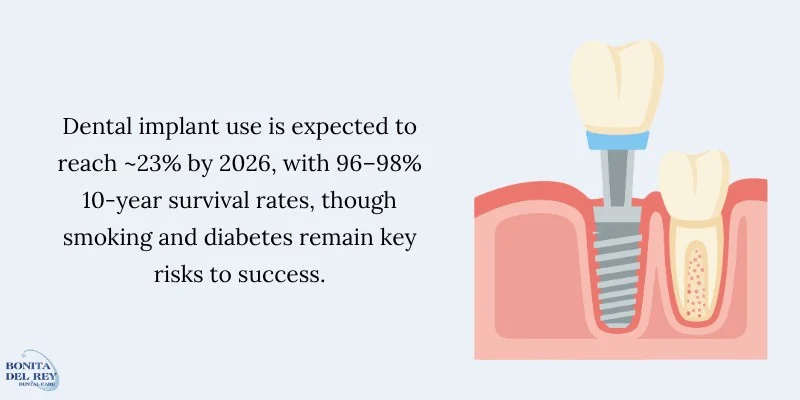
Dental implants have surged in popularity. An estimated 3 million Americans had one or more implants by 2024.
Systematic analysis of NHANES data predicts that implant use among adults with missing teeth could reach ~23% by 2026.
This growth reflects an ageing population and broader insurance coverage. Despite this rise, implants are highly successful long-term: meta-analyses report ≈96–98% survival at 10 years under ideal conditions.
Advanced surgical techniques and materials contribute to these outcomes. However, the absolute number of patients experiencing implant complications will climb as more people receive implants.
The forecasts through 2026 and beyond point to continued growth.
For example, projections accounting for population ageing suggest implant prevalence (among adults with any tooth loss) may nearly double by 2026.
No similar statewide breakdown is available, but California’s share of this market will likely grow given its large population and high income.
Notably, as implants become more common in older patients, managing chronic conditions (smoking, diabetes, etc.) becomes critical to maintain success rates.
Impact of Smoking on Implant Outcomes
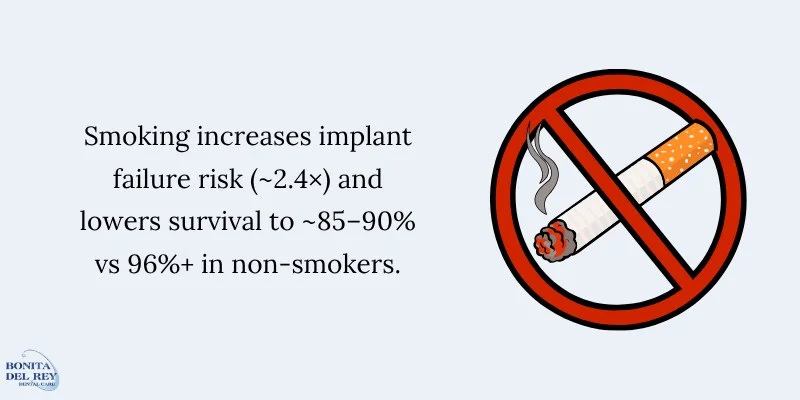
Cigarette smoking is a major risk factor for implant failure. Nicotine and combustion products impair blood flow and bone healing around implants.
Systematic review evidence quantifies this: smokers’ implants have ~2.4 times higher failure risk than non-smokers. In absolute terms, implants placed in smokers fare significantly worse.
For example, one 10-year cohort study found 94.2% survival in non-smokers vs only 85.5% in smokers. Meta-analyses confirm these differences: smokers show greater marginal bone loss (e.g. +0.58 mm loss vs non-smokers) and roughly 140% higher odds of failure.
· Smoking prevalence differences: U.S. (~12–13%) vs California (~9–10%). The higher baseline smoking rate in the U.S. suggests nationally more implants may fail from smoking effects than in CA.
· Clinical effect: Compared to a non-smoker’s implant (≥96% 10-year survival), a smoker’s implant might survive ~85–90%. Meta-analysis odds ratio (OR≈2.40) indicates about 2.4× greater failure risk.
The synergy of tobacco with other factors (poor hygiene, older age) can further escalate complications.
In California, the relatively lower smoking rate means a smaller fraction of implant patients smoke. This should translate to better overall implant outcomes on average.
However, even in CA, nearly 10% of adults smoke, so many implant patients still face this risk. Thus clinicians in California and nationwide emphasize cessation: quitting smoking improves implant healing and reduces peri-implantitis incidence.
Impact of Diabetes on Implant Outcomes
Diabetes – especially poorly controlled – also compromises implant success. Hyperglycaemia impairs wound healing and bone metabolism.
Recent meta-analyses show a clear effect: implants in diabetic patients have about 1.78 times higher failure odds versus non-diabetics.
Pooled data indicate diabetics experience more marginal bone loss (mean +0.776 mm more than non-diabetics) and higher early failure.
Crucially, glycaemic control matters. Studies report that well-controlled type 2 diabetics can achieve implant success rates close to non-diabetics, whereas poor control or long disease duration raises risk.
The Cabello et al. meta-analysis (2022) reported 77.7% higher odds of implant failure in diabetes.
If a non-diabetic’s implant has ~96% 10-year survival, a diabetic’s might be lower (for instance, one report found only ~93% survival in type 2 diabetics over 10 years). Long-standing diabetes is also linked to peri-implantitis.
Because California’s adult diabetes prevalence (~11%) is similar to or slightly above the national rate (~12%), roughly the same proportion of patients have this risk factor.
Chula Vista’s population (with high Latino representation) may have an even higher diabetes burden, potentially making implant management more challenging locally.
In any case, ensuring diabetes is optimally managed is vital: uncontrolled diabetes is a contraindication or warning for implants due to higher complication rates.
Contact us for more information about dental implants in Chula Vista, CA.
Implant Success, Complications and Failure Rates
Dental implants generally succeed at very high rates. A large sensitivity meta-analysis reports a 96.4% pooled survival at 10 years. Even in routine practice, 5- and 10-year survival rates often exceed 90–95%.
However, this overall success conceals subgroup variation. Table: Implant Outcomes by Risk Factors summarizes typical outcomes and relative risks:
| Patient group | 10-yr implant survival | Relative failure risk (vs healthy) |
| Healthy (non-smoker, non-diabetic) | ~96.4% (baseline) | baseline (OR≈1) |
| Current smokers | ~85.5% | OR≈2.40× (140% higher) |
| Diabetic patients (type 2) | (not explicitly reported) | OR≈1.78× (78% higher) |
In words: a healthy adult’s implant has about 96% 10-year survival. In smokers it may fall to mid-80s%, and diabetics to low-90s%, reflecting their increased failure odds.
Consequently, implant complications (e.g. infection, bone loss) occur more often in these groups.
Without risk factors, failure rates hover around 4% (at 10 years); smokers and diabetics may see failures in ~7–15% of implants, depending on control of risk factors.
Comparing national vs California outcomes: direct data on success rates by region are scarce. However, we can infer that California’s implants as a group should outperform the U.S. average, because Californians smoke less.
For example, if 12% of US adults smoke but only 10% in CA, then 2% fewer patients per capita carry the smoking-related failure risk.
Similarly, California’s slightly lower diabetes prevalence (≈1 percentage point lower) slightly reduces risk. These differences are modest, but non-negligible when scaled to millions of implants.
Moreover, California’s better access to dental care (due to economy and insurance expansions) may improve surgical outcomes. Conversely, urban population pressures or nutritional factors could offset some advantages.
At the clinic level (e.g. in Chula Vista), individual dentist–patient dynamics matter.
For instance, a high-volume implant practice in San Diego might track its own local complication rates, which could be used to refine patient selection.
State dental boards do not systematically report implant outcomes, so published comparisons are rare. We must rely on aggregate risk profiles: lower smoking in CA implies fewer smoking-related implant failures, all else equal.
Future Projections (Beyond 2026)
Looking beyond 2026, the trends are clear: more implants and changing risk profiles. Demographically, the U.S. (and California) population over 65 is growing – and older adults are the primary recipients of implants.
Models suggest implant prevalence could climb to a quarter of edentulous adults by 2026.
Continuing declines in smoking are expected (Healthy People 2030 targets <5%), which should gradually reduce tobacco-related dental complications.
However, trends in diabetes are less favorable: if obesity and aging continue to rise, CDC models project diabetes prevalence will reach ~15-20% within the next decade.
These opposing trends mean the net effect on implant outcomes is mixed. Fewer smokers could improve average success rates.
But more diabetics could heighten complication rates, especially if glycaemic control is not improved. Technological advances (better implant surfaces, guided surgery) may also mitigate some risks.
Importantly, implant registries (e.g. national surveys or registries planned by professional bodies) are starting to track outcomes longitudinally; data from these will refine forecasts.
For now, analysts project that 10-year implant survival should remain in the mid-90% range overall, but individual risk groups may see different trends.
Conclusion
In sum, smoking and diabetes substantially affect dental implant success. In the U.S., where ~1 in 8 adults smokes and ~1 in 8 has diabetes, many implant patients carry these risks.
In California (and Chula Vista specifically), smoking is less common (~10%) while diabetes is about as common (~11%).
This suggests Californians undergoing implant therapy face a lower burden of tobacco-related risk but a similar burden of metabolic risk.
Clinical studies consistently show smokers’ and diabetics’ implants fail far more often than healthy patients’. Providers must weigh these factors in treatment planning.
By 2026 and beyond, implant use will continue to rise (projected to about 23% of edentulous adults), making management of smoking and diabetes critical for sustaining high success rates.
Compared to the national average, California’s lower smoking prevalence may yield slightly better implant outcomes overall, though rigorous local data are needed.
Clinicians and public health officials in San Diego County and elsewhere should consider these epidemiologic differences: targeted smoking cessation and diabetes management can improve implant prognosis.
Future research – including state-level implant registries and predictive models – will clarify how U.S. vs California trends diverge, but current evidence underscores that reducing smoking and optimizing diabetes control are key to maximizing implant success nationwide and in California alike.
Sources: Authoritative public-health data (CDC, state health departments) and peer-reviewed studies were used throughout, as cited above. Detailed references support each statistic and finding.
References:
Tobacco Descriptive Summary – HHSA
Tobacco Trends Brief: Rates By State | American Lung Association
National Diabetes Statistics Report | Diabetes | CDC
Diabetes Descriptive Summary – HHSA
Tobacco Trends Brief: Overall Tobacco Trends Brief | American Lung Association
Trends in Dental Implant Use in the U.S., 1999–2016, and Projections to 2026
Smoking and Dental Implants: A Systematic Review and Meta-Analysis
Smoking effects on Dental Implant and surrounding structures
Diabetes Mellitus and Dental Implants: A Systematic Review and Meta-Analysis
Dental implant survival in diabetic patients; review and recommendations – PMC