If you’ve been looking at your smile in photos and wondering if porcelain veneers could help, you’re not alone.
Many adults in Chula Vista come in curious about veneers but unsure whether their teeth and gums are ready for them.
The answer depends on a few things your dentist can check in person. Healthy gums, enough tooth enamel, and a stable bite are key factors in porcelain veneer candidacy.
Your cosmetic goals also matter because veneers work best for certain imperfections, not every dental concern.
This article walks through the signs that point toward good candidacy, the conditions that might need attention first, and what you can expect at a consultation in Chula Vista.
Key Takeaways
- Healthy gums, enough enamel, and a stable bite are the main physical requirements for veneer candidacy.
- Veneers cover cosmetic issues like stains, chips, and gaps, but they don’t fix decay, gum disease, or bite problems.
- Only an in-person dental exam can confirm whether veneers, or another treatment, are right for your teeth.
Table of Content
- Could You Be a Good Veneer Candidate?
- Which Cosmetic Concerns Can Veneers Address?
- What Might Delay or Rule Out Veneers?
- What Happens at a Veneer Consultation?
- What Are Your Options If Veneers Are Not the Best Fit?
- Choose the Right Treatment for a Healthy Smile
- Frequently Asked Questions
Could You Be a Good Veneer Candidate?
A good candidate for porcelain veneers has healthy teeth and gums, enough enamel for bonding, and a bite that won’t place excessive stress on the finished restoration. These factors help your dentist decide whether veneers are appropriate or if another treatment should come first.
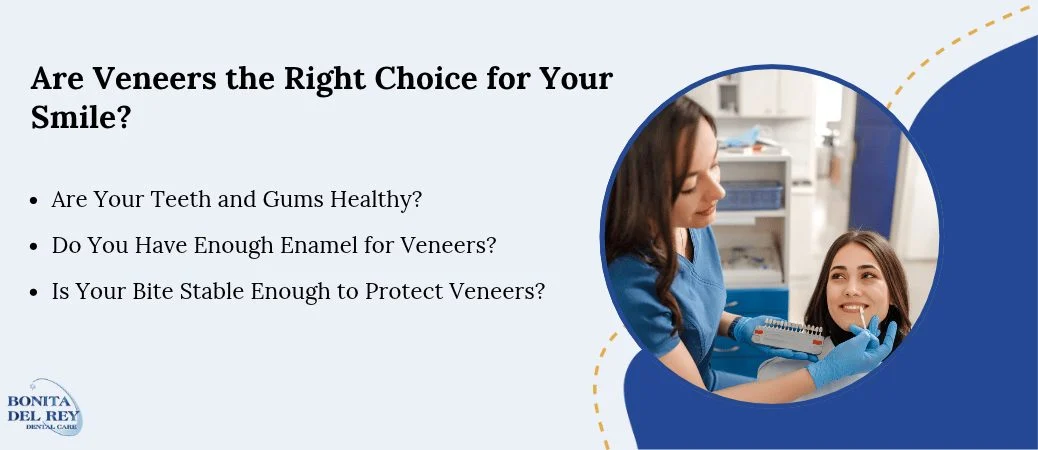
Are Your Teeth and Gums Healthy?
Healthy gums come first. If your gums bleed easily, look puffy, or feel tender, that’s usually a sign of inflammation that needs treatment before any cosmetic work begins.
Veneers are placed close to the gum line, so healthy, stable gum tissue is important for a natural-looking result and long-term maintenance. Your dentist will also check for signs of gum disease before recommending cosmetic treatment.
Do You Have Enough Enamel for Veneers?
Tooth enamel is the surface porcelain bonds to, and there needs to be enough of it for a reliable result.
The amount of enamel needed depends on the tooth, its condition, and how much preparation is required. Your dentist will assess whether enough healthy enamel remains to support a reliable bond.
Teeth with heavy wear, old fillings, or enamel weakened by conditions like fluorosis may not have enough healthy surface left. In those cases, your dentist might suggest a different restoration that doesn’t rely on enamel bonding.
Is Your Bite Stable Enough to Protect Veneers?
A stable bite protects your investment in veneers once they’re placed. If your upper and lower teeth meet unevenly, or if you have a deep overbite or an edge-to-edge bite, those patterns put extra force on the front teeth where veneers usually go.
Bruxism, or teeth grinding, is one of the most common reasons veneers crack or chip early. It doesn’t automatically rule you out, but it does mean your dentist will want a plan in place to protect the porcelain before moving forward.


Which Cosmetic Concerns Can Veneers Address?
Dental veneers work well for cosmetic concerns on the front surface of your teeth, including stains, chips, uneven shapes, small gaps, and mild misalignment.
They’re a cosmetic solution, which means they change how a tooth looks rather than how it functions.
Can Veneers Cover Stains That Whitening Cannot Remove?
Veneers can mask stained or discolored teeth that haven’t responded to teeth whitening.
Deep intrinsic stains, like those from fluorosis or tetracycline exposure, develop within the tooth structure and may not respond well to whitening treatments.
A thin porcelain shell can create a more even tooth color when whitening alone cannot achieve the desired result.
However, teeth whitening may still be a suitable first step for surrounding natural teeth, since porcelain veneers are made to match your chosen shade and will not lighten afterward.
Can Veneers Improve Chips, Wear, or Uneven Tooth Shapes?
Chipped or cracked teeth, worn teeth, and misshapen teeth are among the most common reasons people in Chula Vista look into veneers.
A veneer rebuilds the visible part of a damaged tooth, smoothing out rough edges or restoring length that’s worn away over the years.
This works especially well when the damage is limited to the front surface and the tooth itself is otherwise healthy.
These are some of the common dental issues that porcelain veneers can address, although the right approach depends on your existing teeth and bite.
Can Veneers Close Gaps or Hide Slightly Crooked Teeth?
Gaps between teeth and minor misalignment are both concerns veneers can often address without orthodontics.
A veneer can be shaped slightly wider than the natural tooth to close small spaces, and a well-designed shell can visually straighten teeth that sit a little rotated or uneven.
This has limits. Veneers reshape what you see on the front of a tooth, but they don’t move teeth, so significant crowding or rotation still calls for an orthodontic approach.
For patients considering a full smile makeover, veneers may be combined with other treatments to improve tooth shape, spacing, and overall smile appearance.
What Might Delay or Rule Out Veneers?
Active gum disease, untreated cavities, insufficient enamel, uncontrolled grinding, and significant misalignment are the most common reasons veneer treatment gets delayed.
Some of these conditions can be treated before veneer placement, while others may make veneers unsuitable. Your dentist will evaluate your oral health and recommend the safest treatment option.
Why Must Cavities and Gum Disease Be Treated First?
Cavities and tooth decay have to be treated before veneers go on, because a veneer bonded over a decayed tooth traps the problem underneath instead of fixing it.
Gum disease works the same way: active infection or inflammation can cause the gum tissue to recede later, which exposes the edge of the veneer in a way that looks uneven and invites more decay.
Your dentist will usually want any necessary gum disease treatment completed and your gums stable before scheduling veneer preparation.
What If You Have Insufficient Enamel or Extensive Tooth Damage?
Insufficient enamel changes the conversation quickly. Veneers rely on enamel for a strong, long-lasting bond, so a tooth with heavy wear, large old fillings, or extensive damage to its tooth structure may not hold a veneer reliably.
In these situations, a dental crown may make more sense because it covers and protects more of the tooth. Your dentist may consider options such as same-day crowns when a veneer cannot provide enough protection.
When Are Grinding or Alignment Problems Too Significant?
Bruxism, or teeth grinding, generates forces strong enough to crack porcelain, so unmanaged grinding is one of the more common complications dentists watch for. The usual solution is a nightguard worn at night, which protects the veneer from the extra pressure grinding creates.
Significant bite or alignment problems sometimes call for orthodontic treatment first, since veneers aren’t designed to correct how your teeth come together.
What Happens at a Veneer Consultation?
A veneer consultation starts with an exam of your teeth, gums, and bite before discussing shape, shade, or cost.
Your dentist will also review your cosmetic goals and determine whether veneers alone can achieve the results you want or if planning a complete smile makeover with additional treatments would be a better approach.

How Does a Cosmetic Dentist Assess Your Teeth, Gums, and Bite?
Expect X-rays, a close look at your gum health, and an evaluation of how your upper and lower teeth meet.
This combination lets your dentist rule out decay, confirm your gums are stable, and spot any bite patterns that could put stress on future veneers.
Many offices also take photos or digital scans so you can see a preview of your results before any tooth preparation begins.
What Should You Know About Preparation and Long-Term Care?
Veneer placement usually involves removing a small amount of enamel from the front of the tooth so the porcelain shell sits naturally rather than looking bulky.
This step is permanent, since enamel doesn’t grow back, which is why your dentist will walk through the decision with you carefully before moving forward.
Once your dental laminates are bonded with dental cement, they become a long-term dental solution with proper care.
That means keeping up with oral hygiene, wearing a nightguard if you grind, and seeing your dentist regularly so small issues get caught early.
What Are Your Options If Veneers Are Not the Best Fit?
If veneers aren’t the right fit right now, teeth whitening, dental bonding, composite veneers, orthodontics, or a dental crown may be better starting points depending on what’s holding you back.
None of these options are a downgrade; they’re simply better matched to certain conditions.
When Might Whitening, Bonding, or Composite Veneers Work?
Teeth whitening is worth trying first if your main concern is color and your enamel and gums are healthy.
Dental bonding or composite veneers suit smaller fixes, like a single chip or a narrow gap, especially if you want a quicker, lower-cost cosmetic dental treatment with less commitment than porcelain.
When Are Braces or Invisalign the Better First Step?
Braces or Invisalign may be recommended before veneers when crowding, rotation, or bite problems are significant. Straightening the teeth first can sometimes reduce the number of veneers needed.
When Does a Tooth Need a Crown or Implant Instead?
A dental crown is the better choice for a tooth with extensive damage or too little enamel left to support a veneer, since a crown covers and protects the entire tooth.
Dental implants come into play when a tooth is missing altogether, which is a situation veneers were never designed to address.
Choose the Right Treatment for a Healthy Smile

Porcelain veneers can be a great option when your teeth and gums are healthy and your main goal is to improve tooth color, shape, or spacing.
The right treatment plan should address any underlying dental concerns before focusing on cosmetic improvements.
At Bonita Del Rey Dental Care, Dr. Aldo Espinosa can evaluate your teeth, gums, and bite to determine whether porcelain veneers are right for you.
Whether you’re considering veneers or exploring other cosmetic treatments, our team can help you understand your options and choose an approach that supports your long-term oral health.
Frequently Asked Questions
What disqualifies you from getting porcelain veneers?
Active gum disease, untreated cavities, insufficient enamel, and uncontrolled bruxism are the most common reasons someone isn’t ready for porcelain veneers yet.
These aren’t always permanent, since treating the underlying issue can often open the door to veneers later.
Can you get veneers if you grind your teeth at night?
Yes, but your dentist will likely recommend wearing a nightguard to protect the porcelain from the extra force bruxism creates. Without that protection, grinding can crack or dislodge veneers much sooner than expected.
Do you need to straighten your teeth before getting veneers?
Only if your misalignment is significant. Veneers can disguise minor crookedness or small gaps, but orthodontic treatment is the better option when crowding or rotation is more pronounced, since veneers reshape teeth rather than move them.
What should you know before committing to porcelain veneers?
Enamel removal during preparation is permanent, so a prepared tooth will always need something covering it going forward. It helps to understand this tradeoff clearly, along with the need for a nightguard if you grind, before deciding to move forward.
What is the average cost of porcelain veneers in California?
Porcelain veneer costs depend on the number of teeth treated, the materials used, and your specific cosmetic goals. Your dentist can provide a personalized estimate after examining your teeth and discussing your treatment plan.