Executive summary
No large-scale U.S. surveillance system tracks dental implant failure by concurrent medication class at the individual patient level.
There is no national implant registry linking osseointegration outcomes to a patient’s prescriptions, and no California-, San Diego County-, or Chula Vista-specific implant-outcome dataset exists in the public domain.
Research on medications and dental implant outcomes instead comes from retrospective cohort studies, systematic reviews, meta-analyses, professional-society position papers, and national drug-prescribing prevalence surveys.
This guide synthesizes that evidence and, for the local overlay, relies strictly on demographic and prescribing-prevalence proxies rather than any fabricated local failure rate.
The evidence is uneven across the four drug classes. For bisphosphonates, the concern is not primarily failed osseointegration, implant survival in oral-bisphosphonate users for osteoporosis is generally reported around 95–99%, comparable to non-users, but medication-related osteonecrosis of the jaw (MRONJ).
The American Association of Oral and Maxillofacial Surgeons (AAOMS) 2022 Position Paper on MRONJ (Ruggiero et al., Journal of Oral and Maxillofacial Surgery, 80(5):920–943) frames MRONJ risk as 0.02%–0.05% for oral antiresorptive osteoporosis dosing and substantially higher, cited up to 1%–15%, for oncology/IV antiresorptive therapy.
For SSRIs, the most-cited signal is a cohort study by Wu and colleagues in the Journal of Dental Research (2014), which reported a 10.64% implant failure rate in SSRI users versus 4.63% in non-users, with an adjusted hazard ratio of 6.28 (95% CI 1.25–31.61). For PPIs, a cohort study by Chrcanovic, Kisch, Albrektsson and Wennerberg (Clinical Implant Dentistry and Related Research, 2017) reported failure of 6.8% in PPI users versus 3.2% in non-users, with a hazard ratio of approximately 2.811.
For GLP-1 receptor agonists, there is essentially no direct human dental-implant outcome literature; the discussion is inferential, drawing on weight-loss-associated bone-density effects and perioperative-aspiration guidance from the American Society of Anesthesiologists.
The apparent tensions in the evidence matter. Bisphosphonate risk is procedure- and drug-specific (extraction and IV oncologic dosing dominate MRONJ risk, not osteoporotic oral dosing per se), whereas SSRI and PPI signals are systemic and observational, vulnerable to confounding by the underlying conditions (depression, GERD) and their correlates (smoking, poor bone quality, polypharmacy).
Effect sizes vary widely by study, and small event counts inflate confidence intervals, the SSRI hazard ratio, for instance, carries a very wide interval (95% CI 1.25–31.61). GLP-1 evidence points in two directions simultaneously: rapid weight loss can reduce bone mineral density, but GLP-1 receptor signaling may be relatively bone-sparing.
Because Chula Vista and San Diego County implant outcomes are not publicly reported, all local statements below are exposure-prevalence proxies built from Census demographics and health-survey prevalence, not outcome data.
Comparative metrics
| Metric | GLP-1 agonists | Bisphosphonates | SSRIs | PPIs |
| U.S. adult use | ~12% ever used (KFF, 2024) | Concentrated in women 65+; single-digit % of older adults | 13.2% used in past 30 days (NCHS, 2015–2018) | ~7–8% of adults |
| Most-cited implant finding | No direct human implant data; inferential only | Survival ~95–99% (oral); MRONJ 0.02–0.05% oral vs up to 1–15% IV/oncologic | Failure 10.64% vs 4.63%; adjusted HR 6.28 | Failure 6.8% vs 3.2%; HR ≈ 2.81 |
| Evidence strength | Preclinical/indirect; direct implant data absent | Extensive; multiple reviews + position papers | Several cohort studies; wide CIs | Several cohort studies; moderate |
| Proposed mechanism | Weight-loss BMD change; GLP-1R on bone cells | Osteoclast/bone-remodeling suppression → impaired healing | Peripheral serotonin inhibits osteoblast function; lower BMD | Reduced calcium/magnesium absorption; lower BMD |
What is measured vs. estimated: The implant findings and effect sizes are drawn from published cohort studies and reviews (measured in those study populations).
The U.S. use percentages are national survey estimates. No cell represents a Chula Vista or San Diego County measurement; local exposure is modelled in the outlook section below from demographic and prevalence proxies only.
Bisphosphonates
Mechanism. Bisphosphonates bind bone mineral and suppress osteoclast-mediated resorption, slowing bone turnover.
The therapeutic benefit in osteoporosis (reduced fracture risk) is the same property that, in the jaw, can impair the remodeling needed to heal after invasive procedures, predisposing to MRONJ, an area of exposed necrotic bone.
Quantitative findings. Systematic reviews generally report implant survival in oral-bisphosphonate users for osteoporosis comparable to non-users, commonly cited around 95–99%, with no statistically significant osseointegration-failure difference.
The dominant risk is MRONJ. The AAOMS 2022 Position Paper stratifies MRONJ risk at 0.02%–0.05% for oral antiresorptives at osteoporosis doses (rising with use beyond four years) and up to 1%–15% for high-dose IV/oncologic regimens.
Findings differ across studies because populations differ: oncology patients on IV zoledronic acid or high-dose denosumab are not comparable to postmenopausal women on weekly oral alendronate, and MRONJ triggered by extraction is distinct from risk attributable to elective implant placement.
Duration and cumulative dose consistently emerge as modifiers.
SSRIs
Mechanism. Beyond the brain, serotonin regulates bone: gut-derived peripheral serotonin acts on Htr1b receptors on osteoblasts to inhibit proliferation and bone formation (the Karsenty/Ducy line of work).
SSRIs raise peripheral serotonin availability, a plausible pathway to impaired bone healing, and are independently associated with lower bone mineral density and higher fracture risk.
Quantitative findings. The anchor study, Wu et al., Journal of Dental Research, 2014, reported implant failure of 10.64% in SSRI users versus 4.63% in non-users, with an adjusted hazard ratio of 6.28 (95% CI 1.25–31.61).
Later work (Chrcanovic and colleagues, ~2017) reproduced a higher failure signal in SSRI users. The estimates diverge because of differing failure definitions (implant-level vs patient-level), follow-up windows, and confounding by depression-associated factors (smoking, bruxism, oral hygiene).
No adequately powered 2021–2026 meta-analysis has resolved the effect size, and the very wide confidence interval on the Wu hazard ratio counsels caution about the magnitude.
PPIs
Mechanism. By suppressing gastric acid, PPIs reduce absorption of calcium and magnesium, potentially lowering bone mineral density and impairing the mineral supply for osseointegration; long-term PPI use carries an FDA-noted fracture-risk association.
Quantitative findings. Chrcanovic, Kisch, Albrektsson and Wennerberg (Clinical Implant Dentistry and Related Research, 2017) reported implant failure of 6.8% in PPI users versus 3.2% in non-users, with a hazard ratio of approximately 2.811.
Additional cohort analyses have echoed a modest elevated failure risk.
As with SSRIs, confounding by indication and polypharmacy limits causal inference, though the PPI signal is smaller and more internally consistent than the SSRI signal.
GLP-1 receptor agonists
Mechanism. GLP-1 receptors are expressed on bone cells; preclinical data suggest GLP-1 signaling may modestly favor bone formation or be bone-neutral.
Countervailing concern: rapid, large-magnitude weight loss (as in semaglutide and tirzepatide trials) is generally associated with reductions in bone mineral density.
Quantitative findings. There is essentially no direct human dental-implant outcome literature for GLP-1 agonists as of 2026, this is a genuine gap, and any claim of an implant effect would be speculative.
The more immediate clinical consideration is perioperative planning because GLP-1 medications can delay gastric emptying, which may affect sedation decisions.
Current guidance favors individualized risk assessment rather than assuming every patient should stop the medication on the same schedule.
Patients should follow instructions from their prescribing clinician and dental or anesthesia team rather than stopping a GLP-1 medication on their own.
Who is affected and how implant dentistry is adapting
Exposure is broad and growing. GLP-1 use has expanded rapidly, about 12% of U.S. adults report ever having taken a GLP-1 agonist (KFF, 2024), concentrated in working-age and older adults, precisely the implant-candidate demographic, so the number of implant patients on these drugs is rising even without direct outcome data.
Antidepressant use is common: 13.2% of U.S. adults used an antidepressant in the past 30 days (NCHS, 2015–2018), skewing female and older.
Bisphosphonate/antiresorptive use is concentrated among postmenopausal women and older adults, overlapping heavily with the implant population.
PPI use is widespread and frequently long-term, often beyond guideline-recommended duration.
Implant dentistry has responded chiefly through screening and consent rather than outcome tracking.
Standard practice now includes explicit antiresorptive-history questions in pre-implant workups, while careful treatment planning with guided implant surgery can help support precise implant placement.
The bisphosphonate “drug holiday” debate persists, AAOMS and endocrinology guidance are cautious about routine interruption for low-risk oral users, given uncertain benefit and fracture risk from stopping.
AAOMS, the American Dental Association, and the American Academy of Osseointegration emphasize risk assessment, informed consent about MRONJ, and coordination with prescribers rather than blanket contraindication.
Chula Vista and San Diego County outlook

No implant-failure data specific to Chula Vista or San Diego County exist; the following is a modelled exposure proxy only.
Chula Vista is a large San Diego County city with a population of roughly 275,000 (U.S. Census QuickFacts, ~275,487, 2023 estimate), a median household income near $90,000, a majority Hispanic/Latino population (~59.0%), and about 13.9% of residents aged 65+.
San Diego County totals roughly 3.3 million residents with about 14–15% aged 65+.
Applying national prescribing prevalence to Chula Vista’s adult population yields rough proxy exposure: with antidepressant use at 13.2% and PPI use near 7–8% of adults, tens of thousands of Chula Vista adults plausibly use each class; bisphosphonate exposure concentrates in the older female subgroup; and GLP-1 exposure is expanding in step with local diabetes and obesity prevalence.
These are exposure estimates, not outcome measurements.
They indicate that a meaningful share of local implant candidates are on at least one of these medications, supporting the case for systematic medication screening, without implying any local failure rate.
Regulation, reimbursement, and professional guidance
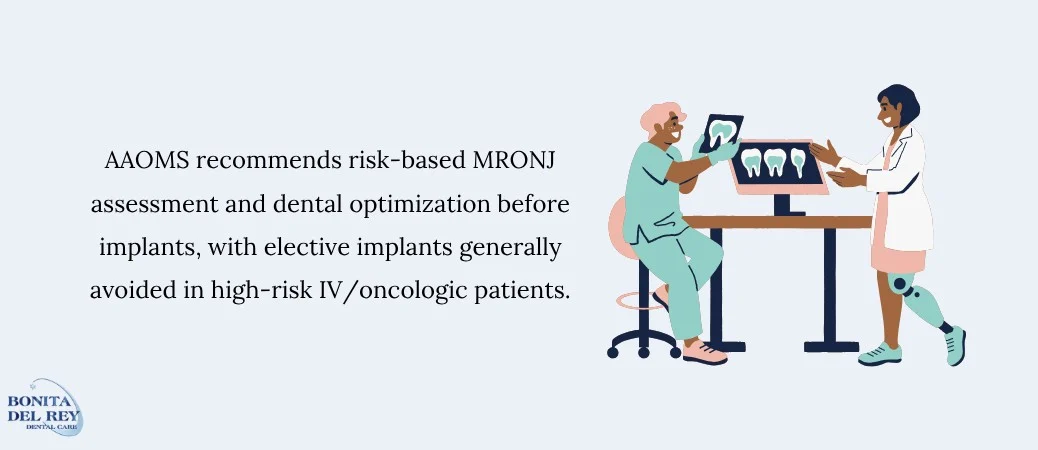
The governing clinical document is the AAOMS 2022 MRONJ Position Paper, which defines staging (0–3), stratifies risk by antiresorptive type/dose/duration, recommends pre-treatment dental optimization for at-risk patients, and generally advises against elective implants in high-risk (IV/oncologic) antiresorptive patients while permitting them with informed consent in low-risk oral-bisphosphonate osteoporosis patients.
FDA labels for oral bisphosphonates (alendronate, risedronate, ibandronate) and IV agents (zoledronic acid) carry osteonecrosis-of-the-jaw warnings advising dental examination before therapy in at-risk patients.
The ASA GLP-1 perioperative guidance affects sedation planning for implant surgery.
For SSRIs and PPIs there is no dental contraindication in labeling; the implications are informed-consent and screening matters.
Forecast, methods, and data gaps

Beyond 2026, expect the GLP-1 question to move from inferential to empirical as prescribing volume creates study populations; MRONJ risk stratification to continue refining by drug and duration (including denosumab); and repeated calls in the literature for a medication-linked implant-outcome registry.
Method. This guide prioritized peer-reviewed oral-and-maxillofacial and implant journals (Journal of Dental Research, Clinical Implant Dentistry and Related Research, International Journal of Oral & Maxillofacial Implants, Journal of Oral and Maxillofacial Surgery, Clinical Oral Implants Research), AAOMS/ADA/AO position papers, FDA labeling, and CDC/NHANES and survey-based prescribing-prevalence data, with U.S.
Census Bureau QuickFacts and California-specific health-survey sources for the local overlay.
Local Chula Vista/San Diego proxy figures were derived by applying national prescribing prevalence to Census demographic counts; they are exposure estimates, not measured outcomes.
A verification constraint applied during preparation: live source retrieval was limited, so specific effect sizes and percentages should be independently reconfirmed against the primary sources listed in the References.
The principal data gap is stark: no large-scale U.S. registry links implant-failure outcomes to concurrent medication use at the individual level, and no California/San Diego/Chula Vista implant-outcome data exist.
Local figures here are exposure-prevalence proxies only, not outcome data.
Recommendations
- Treat the SSRI and PPI signals as hypothesis-generating, not causal, prioritize prospective, confounder-adjusted cohorts before revising risk estimates; the wide SSRI confidence interval is the single most important caveat.
- Treat bisphosphonates as a procedure- and dose-specific MRONJ question, not an osseointegration-failure question, and stratify any analysis by oral-vs-IV and by duration >4 years.
- Treat GLP-1 agonists as an open research frontier: the near-term actionable item is perioperative aspiration risk under sedation, not implant survival.
- For any local (San Diego/Chula Vista) work, build exposure models from Census + CDC PLACES + CHIS and label them as proxies; do not infer local outcomes.
- Thresholds that would change these positions: publication of an adequately powered (>1,000 implants) prospective SSRI or PPI cohort with tight confidence intervals; a GLP-1 implant-outcome study of any design; or launch of a medication-linked implant registry.
Caveats
- All effect sizes and percentages should be reconfirmed against the primary sources listed, as live source verification was constrained during preparation.
- Observational studies here cannot establish causation and are confounded by underlying disease and polypharmacy.
- The GLP-1 implant-outcome literature is effectively absent as of 2026.
- All Chula Vista/San Diego figures are demographic/prevalence proxies, not implant-outcome data, and no such local outcome data exist.
References
Intake of Proton Pump Inhibitors Is Associated with an Increased Risk of Dental Implant Failure
U.S. Census Bureau QuickFacts: Chula Vista city, California
CDC PLACES: Local Data for Better Health
Antidepressant Use Among Adults: United States, 2015–2018 (NCHS Data Brief No. 377)
California Health Interview Survey (AskCHIS), UCLA Center for Health Policy Research