If the idea of being awake during dental implant surgery makes you anxious, understanding your anesthesia options can make treatment feel more manageable.
The key difference between IV sedation vs general anesthesia for dental implants is your level of awareness and how your breathing is managed.
With IV sedation, you remain deeply relaxed and usually breathe on your own. With general anesthesia, you are fully unconscious, and an anesthesia provider supports and monitors your breathing.
Both approaches still use local anesthetic to numb the surgical area, so sedation primarily manages anxiety, awareness, and memory while local anesthesia controls pain.
Your procedure length, anxiety level, medical history, and treatment complexity can all influence which option may be appropriate for your implant surgery.
Key Takeaways
- IV sedation keeps you breathing on your own and lightly responsive; general anesthesia makes you fully unconscious with breathing support.
- Surgical scope, anxiety level, gag reflex, and medical history drive the choice more than personal preference alone.
- General anesthesia costs more because it requires a dedicated anesthesia provider, more equipment, and longer monitored recovery.
Table of Content
- The Core Difference: Awareness, Pain Control, and Breathing
- Which Option Fits Your Dental Implant Procedure?
- Safety, Screening, and Airway Management
- Recovery Time, Side Effects, and Costs
- Choosing the Safest Implant Anesthesia Plan for You
- Frequently Asked Questions
The Core Difference: Awareness, Pain Control, and Breathing
The difference between IV sedation and general anesthesia is a matter of degree along one continuous scale, and the line is drawn at your ability to breathe and protect your own airway.
Sedation depth runs from mild relaxation through moderate and deep sedation into full unconsciousness, and your provider can move you along that scale by adjusting the medication in your IV.
| IV Sedation (Moderate) | General Anesthesia | |
| Awareness | Drowsy, lightly responsive | Fully unconscious |
| Memory of surgery | Little to none | None |
| Breathing | On your own | Supported, often with a tube |
| Airway device | Rarely needed | Breathing tube or LMA |
| Typical setting | Dental office | Office suite, surgery center, or hospital |
| Recovery in chair | 30 to 60 minutes | 1 to 2 hours plus |
What Does IV Sedation Feel Like During Implant Surgery?
Most patients describe intravenous sedation as a warm, heavy calm that arrives within a minute or two of the medication entering the IV line.
You may hear voices, respond to a request to turn your head, and still remember none of it afterward.
That memory gap is the amnesic effect of the sedative medications, and for anxious patients it is the whole point.
A common description of this state is twilight sleep, where you remain technically awake and breathing on your own.
Your gag reflex softens. Your muscles loosen. Time compresses, so a two-hour appointment feels like twenty minutes.
What Happens Under General Anesthesia?
General anesthesia shuts down consciousness completely and suppresses your respiratory drive, which is why your anesthesia provider takes over your breathing.
That usually means an endotracheal tube placed through the mouth or nose, or a laryngeal mask airway resting above the vocal cords.
Your protective reflexes, including the gag reflex and your ability to clear your own airway, go offline. Deep muscle relaxation helps the surgeon work in a still field, which matters for long full-arch cases.
You will remember nothing from the moment the medication takes effect until you wake up in recovery.
Why Sedation Does Not Replace Local Anesthetic
Every implant placement includes local anesthesia, no matter how deeply you are sedated.
The sedative medications act on your central nervous system to reduce awareness and anxiety, while the local anesthetic blocks pain signals at the surgical site itself.
Skip the numbing and even a deeply sedated patient will react to the drill. Local anesthesia and sedation work as a pair, and understanding that pairing is part of how to prepare for dental implants with realistic expectations.


Which Option Fits Your Dental Implant Procedure?
Most single and multiple implant placements are handled comfortably with local anesthesia plus IV sedation, while general anesthesia is reserved for select cases involving extensive surgery, severe dental phobia, or medical and behavioral factors that make awake treatment unsafe.
Procedure length, the number of sites being worked on, and whether grafting is involved all push the decision one way or the other.
When IV Sedation May Be Enough for Implant Placement
IV sedation covers the large majority of implant work: one or two implants, a straightforward tooth extraction with immediate placement, or a site that needs modest bone grafting.
It also suits patients who tried nitrous oxide (laughing gas) or oral sedation for past dental procedures and found neither took the edge off enough.
IV moderate sedation is titrated, meaning your sedation dentist adjusts the dose in real time instead of hoping a pill lands right.
If you are weighing same-day versus traditional implant timelines, know that a longer same-day appointment often still fits comfortably within IV sedation.
When General Anesthesia May Be Recommended
General anesthesia comes into the conversation for full-arch reconstruction such as All-on-4, multi-quadrant surgery combined with sinus lifts or ridge augmentation, and cases where several hours of complete stillness are required.
It is also the right call for patients whose dental phobia is severe enough that they cannot tolerate any awake treatment, and for those with physical or intellectual disabilities that make cooperation in the chair unrealistic.
How Anxiety, Gag Reflex, and Treatment Length Affect the Plan
A strong gag reflex is one of the most underrated reasons patients end up in deeper sedation.
Impressions, retractors, and posterior implant sites all trigger it, and a patient who gags every ninety seconds makes precise work harder and longer.
Anxiety works the same way. Elevated heart rate and tense jaw muscles stretch a procedure out, which in turn increases how much sedation you need.
Be honest about past dental experiences when you ask questions before dental implant surgery.
Safety, Screening, and Airway Management
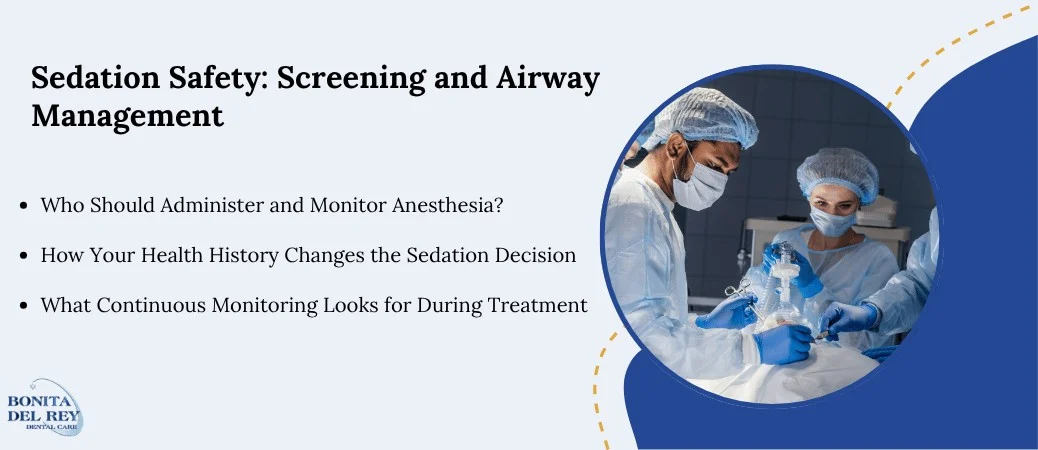
Anesthesia safety in implant dentistry rests on three things: who is giving the medication, how thoroughly you were screened beforehand, and what is being watched second by second while you are under.
Deeper sedation demands more of all three.
Who Should Administer and Monitor Anesthesia?
For moderate IV sedation, a trained sedation dentist or oral surgeon with a state sedation permit can administer and monitor the medication while a trained assistant watches vitals.
For deep sedation and general anesthesia, you want a dedicated anesthesia provider whose only job is you, not the surgery.
How Your Health History Changes the Sedation Decision
Sleep apnea is an important consideration when planning IV sedation or general anesthesia.
An airway that collapses during natural sleep collapses more readily under sedative medications, and patients with obstructive sleep apnea tolerate sedation poorly.
Other factors that reshape the plan:
- Diabetes, especially insulin-dependent, which affects fasting instructions and blood sugar management
- Cardiovascular disease, which changes how your body handles blood pressure shifts
- Prior allergic reactions to local anesthetics, benzodiazepines like midazolam, or other sedatives
- Personal or family history of malignant hyperthermia, a rare inherited reaction to certain general anesthetic agents
- GLP-1 medications, since delayed stomach emptying raises aspiration risk; the timing rules around taking Ozempic before IV sedation have changed in recent years
- Current medications and supplements, including anything that thins blood or interacts with sedatives
Bring your actual medication bottles or a printed list to the consultation. Guessing at doses is how screening gaps happen.
What Continuous Monitoring Looks for During Treatment
Continuous monitoring during IV sedation tracks oxygen saturation with a pulse oximeter, heart rate and rhythm, blood pressure at set intervals, and exhaled carbon dioxide to confirm you are moving air.
That last one, capnography, catches respiratory depression before your oxygen level ever drops. Under general anesthesia, monitoring adds airway pressures and mechanical ventilation settings.
Suction stays ready throughout to protect against aspiration, since implant surgery produces irrigation fluid and blood in a mouth that is being worked on.
Recovery Time, Side Effects, and Costs
Recovery from IV sedation runs shorter and lighter than recovery from general anesthesia, and the cost difference follows the same pattern. Both require an adult driver and a quiet day at home.
How Long Does It Take to Recover From Each Option?

After IV sedation, most patients are alert enough to walk out with assistance in 30 to 60 minutes, though grogginess lingers for several hours and you should not drive, work, or sign anything important for a full 24 hours.
General anesthesia adds a longer stretch in a post-anesthesia care unit, often one to two hours, while your breathing, reflexes, and blood pressure return to baseline. Plan for the rest of the day to be gone.
Neither timeline is the same as surgical healing. The implant healing process runs on its own schedule of weeks to months.
What Side Effects Can Occur After Sedation or Anesthesia?
Common after IV sedation: drowsiness, mild dizziness on standing, a dry mouth, and patchy or absent memory of the appointment. Some patients feel slightly nauseated.
General anesthesia carries a higher rate of postoperative nausea and vomiting (PONV), plus a sore throat from the breathing tube and occasional shivering as you warm back up.
Tell your provider if you have had PONV before, since preventive anti-nausea medication is given during surgery.
Sedation side effects are separate from surgical soreness, and managing post-implant discomfort follows its own plan.
Why General Anesthesia Usually Costs More
General anesthesia costs more because it adds a second licensed professional, more equipment, extra medications, and a longer monitored recovery to the bill.
Anesthesia is billed separately from the implant placement fee.
IV sedation is billed by the hour or in time increments in most practices, so a longer surgery raises the sedation line item.
Ask for the anesthesia fee in writing before the day of surgery, since it is one of the costs that surprise implant patients at checkout.
Choosing the Safest Implant Anesthesia Plan for You

The safest anesthesia option for your implant surgery is the least invasive one that lets your surgeon finish the work while you stay comfortable and stable.
For most people, that is local anesthesia paired with IV sedation.
For full-arch cases, extensive grafting, severe phobia, or complicated health histories, general anesthesia with a dedicated anesthesia provider earns its place.
Go into your consultation with three things ready: a complete medication list, an honest account of your anxiety and gag reflex, and a question about who will monitor you and where.
Before setting a surgical date, make sure part of your consultation includes choosing the right implant provider for your specific case.
Frequently Asked Questions
Can you still feel pain with IV sedation for dental implants?
No, because local anesthetic numbs the surgical site regardless of sedation depth. You may sense pressure or vibration, but the sharp pain signal is blocked at the nerve.
If anything hurts during the procedure, you can signal your provider and more local anesthetic is given.
Do you breathe on your own with IV sedation?
Yes. Moderate IV sedation preserves your respiratory drive, so no breathing tube is needed and you keep your protective reflexes.
Your oxygen saturation and exhaled carbon dioxide are monitored continuously in case the sedation drifts deeper than planned.
Is IV sedation less risky than general anesthesia for dental implants?
Moderate IV sedation carries fewer airway-related risks because you keep breathing independently and no breathing tube is placed.
General anesthesia has an excellent safety record when delivered by a qualified provider with proper monitoring. The bigger safety variable is provider training and setting, not the technique alone.
Is deep IV sedation the same as general anesthesia?
No, though they sit close together on the sedation continuum. Under deep sedation you are hard to rouse but still breathing on your own, while general anesthesia means full unconsciousness with breathing support.
Deep sedation can slide into general anesthesia unintentionally, which is why the same rescue capability is required for both.
How much more does general anesthesia cost for dental implant surgery?
General anesthesia costs more than IV sedation because it adds a dedicated anesthesia provider, additional equipment and medications, and a longer monitored recovery.
Practices price anesthesia separately from the implant fee and by the length of the procedure, so ask for a written estimate at your consultation.
Which option is better for full-arch dental implants and bone grafting?
Full-arch cases and extensive bone grafting lean toward general anesthesia or deep sedation with a dedicated anesthesia provider, since they involve several hours of work and require you to stay completely still.
Shorter grafting paired with a single implant is handled comfortably under moderate IV sedation. Your surgeon’s estimate of chair time is the clearest predictor.