For a 2026 dental implant quality of life study in the United States, the strongest public evidence base is not a single national quality-of-life registry.
Instead, it is a multi-source synthesis that combines: national epidemiology on implant uptake, U.S. cohort studies with patient-reported outcomes, complication and maintenance literature, and local access data.
That is the most defensible design for this topic because the United States has strong data on who gets implants and expanding but still incomplete data on how patients feel and function years later.
A major reason is that a new National Dental Practice-Based Research Network implant registry is only now being built to collect longitudinal complications and patient-reported outcomes in community practice; its protocol plans to follow about 1,550 patients, 2,000 implant restorations, and 150 practitioners over three years.
That matters methodologically. If you are writing this up for research use, the key question should not be framed as “What does one national U.S. dataset prove about long-term implant quality of life?” but rather: What does the best current U.S. evidence suggest about long-term oral health-related quality of life, and where are the data gaps?
The present evidence supports a cautious but clear conclusion: for appropriately selected patients, implants are associated with better long-term function, comfort, aesthetics, and satisfaction than unresolved tooth loss or unstable prostheses, but the realised benefit depends heavily on maintenance access and the patient’s risk profile.
What recent U.S. data show about uptake and likely quality-of-life benefit
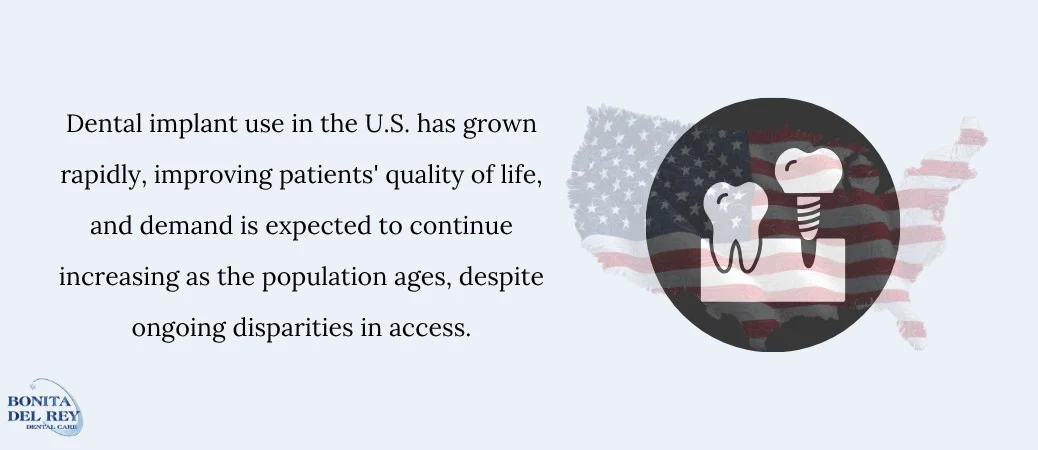
National uptake has risen sharply. In NHANES-based analysis of U.S. adults aged 50 years and older, the prevalence of having at least one dental implant rose from 1.3% in 1999–2004 to 8.4% in 2015–2020.
The same study found persistent disparities: implant prevalence was lower among people who were non-Hispanic Black, experiencing poverty, or had less than a college education.
Earlier U.S. modelling projected implant prevalence in 2026 anywhere from 5.7% under conservative assumptions to 23% under the least conservative scenario, with an average adjusted increase of about 14% per year over the 1999–2016 period.
Read alongside the later NHANES analysis, the implication is that demand has continued to grow, but access remains socially uneven rather than universal.
Recent U.S.-linked patient-reported evidence is smaller, but clinically meaningful.
A University of Texas–associated prospective cohort on mandibular two-implant overdentures in type 2 diabetic and non-diabetic edentulous patients reported significant improvements in satisfaction and oral health-related quality of life, and those gains extended even to patients with poorly controlled glycaemia.
This is one of the most relevant recent U.S. studies because it focuses on a common American high-risk group and measures outcomes patients actually feel: function, comfort, and day-to-day benefit.
This fits the broader U.S. public-health context. NIDCR notes that the older U.S. population is growing rapidly, that 1 in 6 Americans is already over 65, and that by 2030 the proportion will be 1 in 5.
NIDCR also explicitly links this ageing trend to increased expectations for good oral health-related quality of life and to greater demand for dental care, including restorative care.
What sustains quality of life over the long term
The most important point for long-term quality of life is that implant survival is necessary but not sufficient.
A surviving implant can still deliver poor quality of life if it is painful, hard to clean, aesthetically disappointing, or burdened by repeated maintenance.
The 2026 National Dental PBRN registry protocol summarises the current literature as showing 5-year survival rates of roughly 90% to 96.2%, but it also warns that such figures may not fully capture outcomes in ordinary community practice.
That warning is important in a U.S. setting, where much care happens outside academic centres.
Complications are the main reason long-term quality of life can flatten or deteriorate.
A recent JADA review reported that studies have found peri-implant mucositis in up to 80% of implant patients, with roughly 20% progressing to peri-implantitis.
The 2024 AO/AAP consensus identified major risk factors as a history of periodontitis, smoking, uncontrolled diabetes, and poor microbial biofilm control.
These risk factors are not abstract. In the United States, NHANES-based work found that about 42% of dentate adults aged 30 and over had periodontitis, including 7.8% with severe periodontitis.
Because periodontitis is both a major cause of tooth loss and a recognised peri-implant risk factor, long-term implant quality of life in U.S. patients is tightly bound to periodontal control before and after implant placement.
Smoking further increases the risk of implant failure and oral disease burden.
For research purposes, the practical lesson is this: the strongest predictor of sustained implant-related quality of life is not merely placement success, but access to ongoing maintenance.
Supportive peri-implant therapy, plaque control, recall visits, and timely management of mucositis are what keep a successful treatment from turning into a chronic burden.
Evidence showing common peri-implantitis in patients without regular supportive therapy reinforces that point.
Access, insurance and why Chula Vista matters

In the United States, the biggest barrier to translating implant efficacy into population-level quality-of-life benefit is coverage.
Medicare’s public-facing coverage page states that, in most cases, Medicare does not cover routine dental services or items such as dentures and implants.
CMS makes the same point for providers: dental services are generally excluded unless they are inextricably linked to another covered medical service, such as transplant preparation, head and neck cancer care, or certain dialysis-related situations.
California’s Medicaid programme is broader on basic dental care, but still restrictive for implants. DHCS states that Medi-Cal Dental covers examinations, cleanings, tooth extractions, fillings, root canals, crowns, periodontal maintenance, and complete or partial dentures.
However, the 2026 Medi-Cal Dental Provider Handbook specifies that implant services are a benefit only when exceptional medical conditions are documented and prior authorisation is obtained; examples include oral cancer with ablative surgery or radiation, severe jaw atrophy incompatible with conventional prostheses, certain skeletal deformities, and traumatic destruction of the jaw or face.
That restriction helps explain why implant use rises fastest among more advantaged groups.
Nationally, poorer oral health and lower dental access are more common among people who are low-income, uninsured, and members of racial or ethnic minority, immigrant, or rural populations.
For Chula Vista, the local relevance is substantial. Census QuickFacts estimates a 2025 population of 275,533, with 13.4% aged 65 and over.
The city is 61.1% Hispanic or Latino, 29.4% foreign-born, and 57.4% of residents aged five and over speak a language other than English at home; among those under 65, 7.2% are uninsured.
These demographics do not determine outcomes by themselves, but they strongly suggest that any local implant quality-of-life study should pay close attention to language access, insurance status, and older-adult maintenance needs.
San Diego County data sharpen that picture. According to the County’s 2026 oral-health needs assessment, 32% of Latino adults in the county had not visited a dentist in the past year, and about one in three Latino adults did not have dental insurance. Among seniors, 36% lacked dental insurance, and although 78% of seniors overall reported a dental visit in the past year, only 28% of seniors on Medi-Cal received an annual dental visit in 2023.
The implication for Chula Vista is straightforward and research-relevant: even if implants can markedly improve quality of life, those gains will be unevenly distributed unless patients can access regular reviews, hygiene support, repair, and peri-implant disease management.
In a majority-Latino border-region city with a sizeable older population, long-term implant quality of life is therefore inseparable from equity in follow-up care, not just from the surgical event itself.
What is most likely beyond 2026
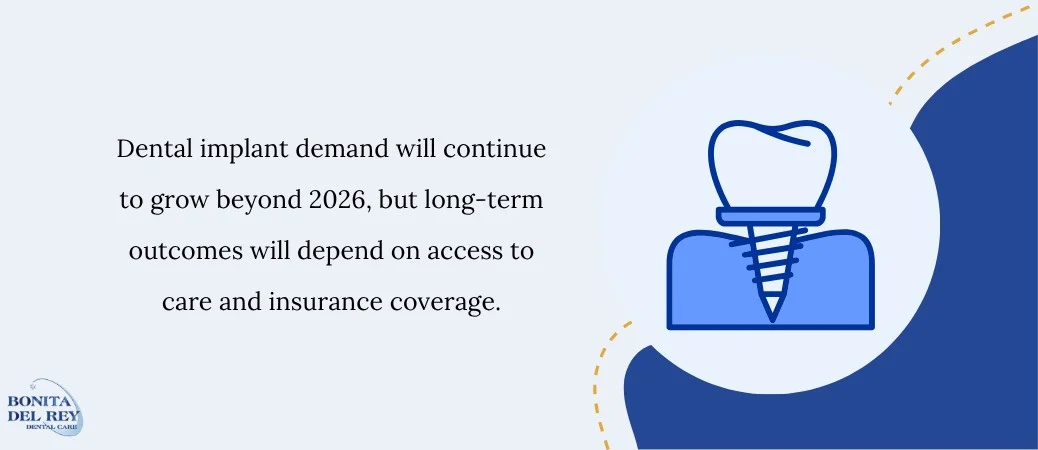
The demand side is likely to keep rising. NIDCR expects a larger and more diverse older adult population, more retained teeth, and greater demand for preventive and restorative oral care.
At the same time, NHANES-based analyses show that implant uptake has been climbing for years, and earlier modelling already anticipated continued expansion through 2026.
The more interesting shift beyond 2026 is likely to be better U.S. measurement, not just more implants.
The new National Dental PBRN implant registry is designed specifically to generate real-world, community-practice evidence on biological and prosthetic complications together with patient-reported outcomes.
If completed, it should begin to close the biggest U.S. research gap in this field: the absence of large-scale longitudinal evidence linking implant status, complications, and everyday quality of life in ordinary American dental settings.
So, the most defensible forecast is not that post-2026 implant quality of life will automatically improve, but that it will become better understood.
Actual outcomes will probably continue to diverge by insurance, maintenance access, gum disease risk, and chronic disease control.
If coverage rules stay largely unchanged, the U.S. may see both more implants overall and persistent inequality in who sustains their benefits long term.
Bottom line for a research paper
A strong 2026 research conclusion would be: Dental implants in U.S. patients appear to deliver durable quality-of-life gains, especially in chewing ability, prosthesis stability, comfort, and patient satisfaction, but the long-term benefit is conditioned by maintenance, peri-implant disease risk, and insurance-mediated access to follow-up care.
The evidence is strongest for increasing utilisation and persistent disparities, moderately strong for sustained clinical durability, and promising but still comparatively thin for large-scale U.S. patient-reported outcomes.
If you are positioning the paper around Chula Vista, California, the most credible local angle is not to claim city-specific implant outcomes that public data do not presently provide.
It is to argue that Chula Vista’s demographic profile, San Diego County’s documented dental access gaps, and California’s insurance rules together create a setting in which the quality-of-life benefits of implants are probably real but unevenly realised.
That is a researchable, evidence-based, and properly bounded conclusion for 2026.
References
[1] The National Dental Practice-Based Research Network …
[2] [5] Satisfaction and quality of life in a prospective cohort study
[3] [19] Implant and implant restoration trends among adults 50 …
[4] Trends in Dental Implant Use in the U.S., 1999-2016, and …
[6] [17] Oral Health in America – May 2022 Bulletin | NIDCR
[7] The National Dental Practice-Based Research Network … – PMC
[8] Efficacy of supportive peri-implant therapy in …
[9] Periodontitis in US Adults: National Health and Nutrition …
[10] Peri-implantitis in patients without regular supportive therapy
[11] [18] Dental service coverage
[13] Disparities in Access to Oral Health Care – PubMed – NIH
[14] [16] [20] U.S. Census Bureau QuickFacts: Chula Vista city, California
[15] Standard Report Template – Multi-color lines