Nobody wants to hear they need a tooth pulled. But sometimes removing a tooth is the best way to protect your oral health and prevent bigger problems down the road.
When a tooth cannot be repaired with a filling or crown, when it breaks at the gum line, or when wisdom teeth become impacted, a surgical extraction may be your best option to maintain a healthy smile.
You might wonder what makes a surgical extraction different from a regular one. A simple extraction happens when your dentist can easily remove a visible tooth with forceps, while a surgical extraction requires removing gum tissue or bone to take out the tooth.
This might sound intense, but modern dental technology makes the process safe and comfortable.
Understanding surgical tooth extractions benefits will help you feel more confident if your dentist recommends one. From impacted wisdom teeth to severely decayed teeth, there are clear reasons why this procedure can be the right choice for your long-term dental health.
Key Takeaways
- Surgical extractions are needed when teeth cannot be removed simply, such as impacted wisdom teeth or teeth broken at the gum line
- The procedure is safe and comfortable with modern dental techniques, and proper aftercare leads to quick recovery
- Following your dentist’s post-extraction instructions carefully prevents complications and promotes faster healing
Understanding Surgical Tooth Extractions
Surgical tooth extractions involve additional steps beyond routine tooth removal to handle more complex dental situations. These procedures require specialized techniques to safely remove teeth that can’t be extracted through standard methods.
What Is a Surgical Extraction?
A surgical tooth extraction is a dental procedure that includes extra steps not needed during routine removals. Your dentist may need to make an incision in your gum tissue to create a flap that gets peeled back. This gives them access to the bone and tooth underneath.
The procedure might also involve removing some bone tissue around your tooth. This creates an opening to help remove the tooth more easily. Your dentist may also cut the tooth into smaller pieces so each section can be taken out separately.
You’ll receive local anesthesia to numb the area during the procedure. Some cases may require general anesthesia or sedation, especially for more involved extractions. The type of anesthesia depends on the complexity of your case and your comfort level.
Surgical vs. Simple Extraction: Key Differences
A simple extraction works for teeth that are visible in your mouth and can be removed with basic dental tools. Your dentist uses forceps to grasp the tooth and gently rock it back and forth until it loosens from the socket.
Surgical extractions require additional techniques that simple extractions don’t use. These include:
- Gum tissue flaps – cutting and folding back gum tissue
- Bone removal – trimming away bone that blocks access to the tooth
- Tooth sectioning – dividing the tooth into smaller pieces
Simple extractions typically take just a few minutes and involve minimal recovery time. Surgical extractions take longer and require stitches to close the gum tissue. Your healing time will be extended compared to a simple extraction.
When Surgical Extraction Is Recommended
Your dentist recommends surgical extraction when your tooth presents specific challenges. Broken or severely damaged teeth often need this approach because there isn’t enough tooth structure above the gum line to grasp with forceps.
Impacted teeth that remain buried under gum tissue or bone require surgical removal. Wisdom teeth commonly fall into this category. Teeth with long, curved, or multiple roots may also need surgical extraction to prevent breaking during removal.
Dense bone surrounding your tooth can make standard extraction difficult. This often happens with age or from teeth grinding. Fragile teeth with cracks might break during a regular extraction, making a surgical approach safer from the start.
Your oral health benefits when your dentist chooses surgical extraction for these situations. The extra steps reduce trauma to surrounding tissues and lower the risk of complications during the tooth extraction process.
Concerned about a damaged or impacted tooth? Explore professional tooth extraction services at Bonita Del Rey Dental Care in Chula Vista, CA, to get expert care.
When Surgical Extractions Are the Best Choice for Dental Health
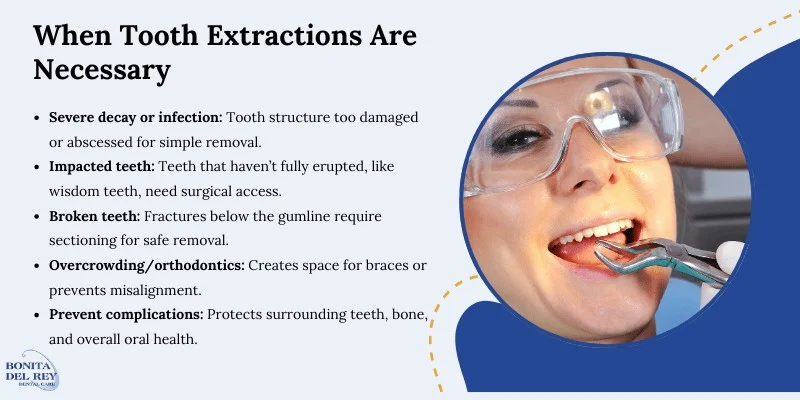
Certain dental conditions require more than a simple tooth removal to protect your overall oral health. Surgical extractions become necessary when teeth are difficult to access, severely damaged below the gumline, or causing complications that could affect surrounding teeth and bone.
Severe Tooth Decay or Infection
When severe tooth decay extends deep below your gumline, a surgical extraction may be your only option. The decay can compromise the tooth structure so much that the tooth breaks apart during removal attempts.
In these cases, your dentist needs to make an incision in your gum tissue to access all the tooth fragments.
A tooth infection that develops into an abscess presents another situation where surgical extraction becomes medically necessary. The infection can spread to surrounding bone and tissue, creating serious health risks.
While a root canal might save some infected teeth, advanced infections often require complete tooth removal through surgical methods.
Your dentist will evaluate whether the infection has damaged too much of the tooth structure to save. If the decay reaches the tooth root or if an abscess has formed, surgical extraction prevents the infection from spreading to other areas of your mouth.
Complications from Impacted or Broken Teeth
Impacted teeth that haven’t fully erupted through your gums need surgical removal because they’re not accessible with standard extraction tools. Impacted wisdom teeth are the most common example, but any tooth can become impacted and cause problems.
Broken teeth present unique challenges, especially when the break occurs below your gumline. The dentist or oral surgeon makes a small incision in the gum to access the tooth and may need to remove some bone or divide the tooth into sections. This approach ensures safe removal of all tooth pieces without damaging nearby teeth or bone.
If you have a tooth that fractured from injury or extreme decay, leaving fragments behind can lead to infection. Surgical extraction ensures complete removal of all broken pieces, protecting your long-term dental health.
Overcrowding and Orthodontic Requirements
Overcrowding in your mouth sometimes requires surgical extraction to create space for proper tooth alignment. While simple extractions work for visible teeth, some patients need removal of teeth that haven’t fully emerged or are positioned awkwardly in the jaw.
Before starting orthodontic treatment with braces or Invisalign, your orthodontist may recommend extracting certain teeth surgically. This is especially true if the teeth are partially impacted or positioned in ways that make simple removal impossible. The extraction creates room for your remaining teeth to shift into their correct positions.
Wisdom teeth often cause overcrowding issues as they try to emerge in mouths without enough space. Surgical removal of these teeth prevents them from pushing other teeth out of alignment and undoing previous orthodontic treatments. Your dentist can identify these spacing issues early and recommend surgical extraction before complications develop.
Need professional guidance for a problematic tooth? Reach out today to book a consultation with our dental specialists at Bonita Del Rey Dental Care.
Common Dental Issues Necessitating Surgical Extractions
Several serious dental problems require surgical removal rather than simple extraction. These conditions often involve teeth that can’t be easily accessed, bones that need adjustment, or extensive damage below your gum line.
Advanced Gum Disease and Periodontitis
When you have periodontal disease, the supporting bone and tissue around your teeth gradually break down. Advanced gum disease destroys the structures that hold your teeth in place.
In severe cases of periodontitis, your teeth become loose because they lack proper bone support. Your dentist may recommend surgical extraction when these teeth can’t be saved through other treatments. The procedure removes the damaged tooth and allows your oral surgeon to clean out infected tissue from the socket.
Signs you might need extraction due to gum disease:
- Teeth that move or feel loose when you touch them
- Deep pockets between your teeth and gums
- Bone loss visible on dental X-rays
- Persistent infections that don’t respond to antibiotics
Sometimes the bone around diseased teeth becomes dense or fuses to the tooth root. This makes surgical removal necessary to protect your surrounding healthy teeth and gums.
Dental Injuries and Complex Root Structures
Dental trauma can cause teeth to break at or below your gum line. Surgical extractions become necessary when a tooth fractures in a way that leaves fragments under the gum tissue. Your dentist needs to make an incision to access and remove these broken pieces completely.
Some teeth naturally have long or curved roots that make simple removal impossible. Third molars, commonly called wisdom teeth, often have roots that curve around your jawbone. Your oral surgeon must carefully cut away bone and tissue to extract these teeth without causing damage.
Root tips can also snap off during a tooth removal procedure. When this happens, surgical intervention becomes necessary to retrieve the remaining fragments and prevent infection.
Preparation for Dentures or Implants
Your mouth needs proper preparation before you can receive dental implants or dentures. Surgical extractions allow your oral surgeon to reshape your jawbone and remove damaged teeth that would interfere with your new prosthetics.
When you’re getting full or partial dentures, any remaining damaged teeth must be surgically removed. Your surgeon can smooth the bone ridges during the same procedure to create a better fit for your dentures.
For dental implant placement, surgical extraction creates the proper foundation in your jawbone. Your surgeon may perform bone grafting at the same time to ensure enough bone density for the implant post. This combined approach reduces your total treatment time and number of procedures.
The Surgical Extraction Process: What to Expect

Your dentist will evaluate your specific situation and plan the best approach for your surgical extraction. The process includes a thorough examination, choosing the right type of anesthesia for your comfort, and following specific steps to safely remove the tooth.
Diagnosis and Pre-Procedure Evaluation
Your dentist will start with a complete exam of the tooth that needs removal. They’ll take X-rays to see the position of the tooth’s roots and check how much bone surrounds it. This helps them plan which techniques they’ll need to use during your dental procedure.
The evaluation also looks at your medical history. You’ll need to tell your dentist about any medications you take and health conditions you have. This information helps them choose the safest anesthesia option for you.
Your dentist will explain why you need a surgical extraction instead of a simple one. They might need to remove bone around the tooth, cut the tooth into smaller pieces, or create a flap in your gum tissue. Knowing these details ahead of time helps you prepare for the tooth extraction process.
Types of Anesthesia and Sedation Used
Local anesthesia numbs the area around your tooth so you won’t feel pain during the extraction. Your dentist injects this medication into your gums, and it takes effect within a few minutes. You’ll stay awake but won’t feel the work being done.
Some patients need more than just local anesthesia. Your dentist might offer sedation options if you feel anxious or if the procedure will take longer. Nitrous oxide (laughing gas) helps you relax while staying awake and aware.
For more complex cases or if you have severe dental anxiety, your dentist might recommend general anesthesia. This puts you completely to sleep during the procedure. An anesthesiologist monitors you the entire time to keep you safe.
Steps of the Extraction Procedure
Once the anesthesia takes effect, your dentist makes a small cut in your gum tissue. They gently lift this flap back to see the tooth and bone underneath. This gives them better access to work safely.
Your dentist may need to remove some bone around the tooth using a special drill. This step makes it easier to take out the tooth without using too much force. The bone removal is precise and helps ensure a predictable and efficient procedure.
If your tooth has multiple roots or is positioned awkwardly, your dentist will cut it into smaller sections. Each piece comes out separately, which reduces trauma to the surrounding tissue. After removing all pieces, they clean the socket and stitch the gum tissue back into place.
Recovery, Aftercare, and Reducing Risks
Taking care of your mouth after a surgical tooth extraction helps you heal faster and avoid problems. Managing pain, protecting the blood clot, and keeping your mouth clean are the most important steps for a smooth recovery.
Aftercare Tips and Pain Management
Your dentist will place gauze over the extraction site and ask you to bite down gently for at least 30 to 45 minutes to help form a protective blood clot. If bleeding continues, replace it with fresh gauze and maintain gentle pressure.
Managing pain and swelling is a key part of your recovery. Apply an ice pack to the outside of your cheek for 15-minute intervals during the first 24 hours to reduce swelling. Take prescribed pain medication or over-the-counter options like ibuprofen as directed by your dentist.
Stick to soft, cool foods for the first few days. Good choices include:
- Yogurt
- Mashed potatoes
- Applesauce
- Smoothies (without using a straw)
You should avoid smoking and alcohol for at least 72 hours, as both can slow healing and increase complications. Rest is equally important, avoid strenuous physical activity for a day or two since it can increase bleeding and disrupt the healing process.
Preventing Complications Like Dry Socket
Dry socket happens when the blood clot protecting your extraction site gets dislodged or dissolves too early, exposing bone and nerves underneath. This condition can be painful and delay your healing significantly.
To prevent dry socket, avoid using straws for at least a week after your extraction. The sucking motion can pull the clot out of the socket. Don’t spit forcefully, rinse vigorously, or smoke during the first 48 hours.
A focused meta‑analysis of randomized controlled trials specifically comparing chlorhexidine formulations found that both chlorhexidine mouth rinse and chlorhexidine gel significantly reduce the risk of dry socket after molar extractions compared to control groups not using the agent.
The risk ratio for developing dry socket was lower in patients using chlorhexidine: for rinses and gels alike, patients treated with these agents developed fewer dry socket cases than those in control groups.
Watch for warning signs that need immediate attention:
- Pain that gets worse after a few days instead of better
- Heavy bleeding that won’t stop
- Swelling that increases rather than decreases
- Fever or foul-smelling drainage
- Difficulty swallowing or breathing
Contact your dentist right away if you notice any of these symptoms. Prompt treatment can prevent minor issues from becoming serious complications.
Support for Healing and Oral Hygiene
Good oral hygiene supports healing without disturbing the extraction site. Don’t brush near the area for the first 24 hours after surgery. After that, gently rinse your mouth with warm salt water a few times daily, especially after meals.
Avoid mouthwashes with alcohol since they can irritate the wound. Once your dentist says it’s safe, you can use an alcohol-free antibacterial rinse to keep your mouth clean during recovery.
Most simple extractions heal within a week, with significant improvement within 2 to 3 days. Surgical extractions may take slightly longer.
The soft tissue typically closes over the socket in 1 to 2 weeks, though complete bone healing can take several months.
Your oral health and dental health depend on following your dentist’s specific aftercare instructions. Once fully healed, maintain regular brushing twice daily and flossing to protect your remaining teeth and prevent future problems.
Alternatives and Tooth Replacement Solutions
Before choosing extraction, you should know about treatments that might save your tooth, and if extraction becomes necessary, you’ll need to understand your options for replacing the missing tooth to maintain your oral health.
Root Canal Therapy vs. Extraction
Root canal treatment can save a tooth that has infected or damaged pulp inside. During a root canal, your dentist removes the infected material from inside your tooth, cleans the area, and seals it with a special filling material.
This procedure lets you keep your natural tooth instead of having it removed. A root canal typically causes less pain than you might expect, and you won’t need as much pain medication during recovery compared to an extraction.
However, root canal therapy isn’t always successful. If infection returns after a root canal, you might need an apicoectomy, which is a procedure where your dentist removes the tip of the tooth’s root and seals it.
Sometimes extraction becomes the better choice when a tooth is near a significant artery or nerve or when the damage is too severe to repair.
Dental Crowns, Fillings, and Other Treatments
Dental crowns can restore severely damaged teeth without extraction. Your dentist places a crown over your existing tooth to protect it and restore its shape and function.
Fillings work well for treating cavities and minor decay. Your dentist removes the decayed portion and fills the space with a durable material.
For gum disease that threatens your teeth, treatments like LANAP (Laser-Assisted New Attachment Procedure) use specialized laser technology to remove infection and help tissue grow back around your teeth. This approach is less invasive than traditional treatments and can save teeth that might otherwise need extraction.
These dental treatments preserve your natural tooth structure, which is always better for your long-term oral health. Your natural teeth help maintain your jawbone and keep other teeth in proper position.
Tooth Replacement Options After Extraction
Dental implants are considered the best tooth replacement option because they function like natural teeth. A dentist surgically places a titanium post in your jawbone, which fuses with the bone over time. Then a crown attaches to the post, giving you a permanent solution that prevents bone loss.
Dentures replace multiple missing teeth. Full dentures replace all teeth in your upper or lower jaw, while partial dentures fill gaps when you still have some natural teeth remaining. Partial dentures can provide function without removing additional teeth, and they cost less than implants.
Dental bridges use your surrounding teeth as anchors to support a fake tooth in the gap. This option works well if you have healthy teeth on both sides of the missing tooth.
Replacing missing teeth is important because it prevents your other teeth from shifting, maintains your facial structure, and restores your ability to chew and speak properly. The best tooth replacement option depends on your budget, how many teeth you’re missing, and your overall oral health.
Take the first step toward relief: visit Bonita Del Rey Dental Care in Chula Vista, CA, and schedule your surgical tooth extraction.
Frequently Asked Questions
Recovery times vary based on the number of teeth removed and whether you need surgical procedures, while proper preparation and knowing when to see a specialist can make your extraction experience smoother and safer.
What can I expect in terms of recovery time after having multiple teeth extracted?
Your recovery time depends on how many teeth were removed and whether you had a simple or surgical extraction. Most people feel better within a few days, but complete healing of the extraction sites takes longer.
For simple extractions of multiple teeth, you can expect the initial discomfort to fade within three to five days. Surgical extractions typically need one to two weeks for the soft tissue to heal enough for normal activities.
The bone underneath continues healing for several months after your procedure. You’ll likely have stitches if you had surgical tooth extractions that need special care during recovery.
Could you give me some tips on what to do and what to avoid before undergoing a tooth extraction?
Tell your dentist about all medications you’re taking, including vitamins and supplements. Some medications can affect bleeding or interact with anesthesia during your procedure.
Eat a good meal before your appointment since you won’t be able to eat normally for several hours afterward. Arrange for someone to drive you home if you’re having sedation or multiple teeth removed.
Wear comfortable, loose-fitting clothing to your appointment. Avoid smoking for at least 24 hours before the extraction, as it can slow down healing and increase your risk of complications.
In what cases should I consider seeing an oral surgeon instead of a dentist for a tooth extraction?
You should see an oral surgeon when you need impacted wisdom teeth removed or have teeth that are difficult to access. Oral surgeons have extra training in complex extractions and managing bone and tissue.
Consider an oral surgeon if you have medical conditions that make extraction more risky. They’re better equipped to handle complications and can provide stronger sedation options if you’re anxious.
Teeth with long curved roots or those that have broken at the gumline usually need an oral surgeon’s expertise. Your regular dentist will refer you to a specialist if they think your case needs more advanced care.
Are there specific instances where pulling teeth would be categorized as surgical procedures?
A tooth extraction becomes surgical when your dentist needs to remove gum tissue or bone to take out the tooth. Simple extractions involve teeth that are visible above the gumline and can be removed with forceps.
Wisdom teeth that haven’t fully come through the gums require surgical extraction. Teeth that break during removal also turn into surgical procedures, even if they started as simple extractions.
Removing broken-down teeth or root tips requires surgical techniques. Your dentist takes an x-ray before the procedure to determine which type of extraction you need.
What advancements have been made in the tools used for modern tooth extractions?
Modern extraction tools are more precise and cause less trauma to surrounding tissue than older instruments. Today’s forceps and elevators are designed to grip teeth more securely while putting less pressure on the bone.
Better anesthesia options mean you’ll feel comfortable during your procedure. Local anesthetics work faster and last longer, while sedation choices range from mild relaxation to being completely asleep.
Digital x-rays give your dentist a clear view of your tooth’s position and root structure before starting. This technology helps them plan the best approach and avoid complications during the extraction.
After a tooth extraction, how long is it normal to experience pain or discomfort?
Most people have some discomfort for three to five days after tooth extractions. The pain usually peaks within the first 24 to 48 hours and then gradually improves.
Surgical extractions typically cause more discomfort than simple ones and may hurt for up to a week. Your dentist will prescribe or recommend pain medication to help you stay comfortable during healing.
Contact your dentist right away if your pain gets worse after a few days or doesn’t improve with medication. Severe or increasing pain can signal a problem like dry socket or infection that needs treatment.