Waking up with a sore, swollen jaw after bone graft surgery is unsettling, especially when you have been counting on that graft to hold your future implant.
Most bone grafts heal quietly over several months, and a few gritty particles on your tongue or mild tenderness during the first week rarely means anything has gone wrong.
A dental bone graft that fails does not end your implant plan; it usually means the site needs cleaning, healing time, and a second grafting attempt before implant placement moves forward.
That is the part patients rarely hear when they start searching for answers.
Dental bone graft failure is uncommon. When it does happen, it tends to announce itself with pain that grows instead of fades, swelling that peaks late, drainage, or graft material that keeps washing out day after day.
Key Takeaways
- Mild swelling, small gritty particles, and tenderness in the first week are expected; worsening pain, pus, fever, or an opening wound are not.
- Infection, poor blood supply, movement of the graft, smoking, and uncontrolled diabetes are the most common reasons a graft does not take.
- A failed graft can almost always be regrafted after the site heals, and implant placement resumes once enough new bone forms.
Normal Healing vs. Signs of a Graft Problem
Early bone graft recovery looks messier than most people expect: puffy gums, a stiff jaw, oozing at the stitches, and tiny sand-like grains that rinse out.
What separates normal healing from a graft problem is the direction your symptoms are moving.
Improvement by day three or four points to healthy healing, while symptoms that intensify after that point deserve a phone call.
What Is Usually Normal During the First Week?
Swelling peaks around 48 to 72 hours, then eases. Expect a tender jaw, light pinkish saliva for a day, and bruising on the cheek or under the chin if the graft site was large.
You will live on soft foods for a while. Cool, smooth items like yogurt, scrambled eggs, and lukewarm soup protect the blood clot and the graft particles underneath it.
A handful of small white or tan granules escaping into your mouth during the first days is common. The membrane and stitches hold the bulk of the material in place; what escapes is the loose surface layer.
Mild soreness that responds to ibuprofen is expected. Many patients feel noticeably better by the end of week one, with stitches dissolving or removed around days 7 to 14.
Which Symptoms May Signal Infection or Graft Failure?
Pain that increases after day three is the symptom that concerns dental teams most.
Graft granules have no nerve endings, so a strong ache that keeps building usually points to inflammation or infection in the surrounding tissue.
Watch for this cluster:
- Pus or yellow-green discharge from the gum or along the incision
- A foul taste or persistent bad smell that brushing and rinsing do not clear
- Fever or chills, which suggest infection spreading beyond the site
- Redness and swelling that worsen after the first couple of days
- Gum tissue pulling apart, exposing the membrane or graft material underneath
None of these prove the graft has failed. They do mean the site needs to be looked at soon, because early infection control often saves a graft that would otherwise be lost.
When Is Bleeding, Graft Particle Loss, or an Open Wound Concerning?
Bleeding that soaks through gauze after 30 to 45 minutes of steady pressure, or that restarts heavily days later, is worth a visit. Light oozing the first evening is routine.
Losing a few grains is normal healing. Losing a steady stream of material, or feeling a noticeable dent where the graft once sat, suggests the particles are washing out rather than settling into place.
An open wound where the stitch line has separated exposes graft material to saliva and bacteria.
Exposed membrane does not always doom the graft, but the site needs professional cleaning and sometimes trimming of the membrane edge to keep bacteria from working deeper.
Why Dental Bone Grafts Can Fail
A graft fails when new bone never forms in the space the material was holding open.
That happens for a short list of practical reasons: bacteria overwhelm the site, blood vessels cannot reach the graft material, the graft shifts before it stabilizes, or your body’s healing capacity is limited by a habit or health condition.
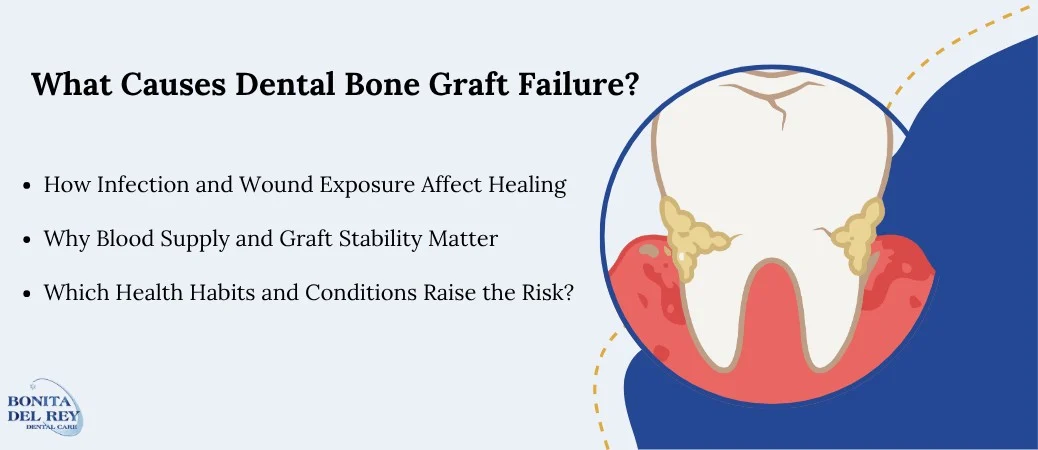
How Infection and Wound Exposure Affect Healing
Bacteria are the leading cause of graft loss. When the gum closure opens, saliva and plaque reach graft material that has no blood supply of its own yet, and bacteria multiply faster than your body can wall them off.
Active gum disease before surgery raises that risk. Periodontal infection should be treated with deep cleaning and improved home care several weeks before grafting, since chronic inflammation in the same jaw undermines healing at the graft site.
The connection between gum disease and dental implant failure applies to grafts placed in that same tissue.
Careful oral hygiene during recovery protects the site. Gentle brushing away from the incision, the prescribed rinse on schedule, and no vigorous swishing for the first days go a long way toward preventing infection around grafts and implants.
Why Blood Supply and Graft Stability Matter
Graft material is a scaffold. Your own blood vessels have to grow into it, carrying cells that slowly replace the particles with living bone, a process called bone integration.
Poor blood supply stalls that process. Dense, thin ridges with little marrow, heavily scarred tissue, and previous surgeries in the same spot all limit blood flow into the graft.
Movement is the other enemy. If the graft site is compressed by chewing, a denture rubbing over it, or tongue pressure, the forming tissue tears repeatedly and never matures into solid bone.
This is why surgeons insist on soft foods, no straws, and leaving temporary appliances out until they say otherwise.
Which Health Habits and Conditions Raise the Risk?
Smoking is the single biggest controllable risk. Nicotine narrows the small vessels that must feed the graft, and the heat and suction of smoking disturb the clot directly.
Poorly controlled diabetes slows wound healing and raises infection risk, which is part of why diabetes changes the planning around dental implants and grafts.
Well-managed blood sugar brings outcomes much closer to average.
Other contributors include long-term steroid use, certain bone medications, heavy alcohol use, untreated grinding, and skipped follow-up visits where a small problem could have been caught early.
What to Do If You Suspect Graft Failure
Contact your surgeon, even if it feels like a small concern and even if it is after hours.
The treating team knows what material they used, how the site was closed, and what your X-ray looked like going in, which makes their read on your symptoms far more useful than any checklist.
When Should You Call the Treating Dental Office?
Reach out during business hours if any of these show up:
- Pain that is worse on day four than it was on day two
- Swelling that started shrinking and then returned
- A bad taste or odor that rinsing does not fix
- A stitch line that has opened or a gray-white membrane now visible
- More than a pinch of graft particles coming out each day past the first week
Describe what changed and when. Many offices can triage over the phone and decide whether you need an appointment tomorrow or a prescription today.
Bringing this concern to your general dentist, periodontist, or oral surgeon promptly is one of the most effective ways to avoid common mistakes after implant and graft surgery.
When Does a Graft Problem Need Same-Day or Emergency Care?
Some symptoms warrant same-day attention rather than a wait-and-see approach:
| Symptom | Why it needs fast care |
| Fever over 100.4°F or chills | Suggests infection spreading beyond the site |
| Visible pus or heavy drainage | Active infection under the tissue |
| Swelling reaching the eye, neck, or floor of the mouth | Risk of airway or deep-space involvement |
| Trouble swallowing or opening your mouth | Needs urgent evaluation |
| Bleeding that will not stop with 45 minutes of firm gauze pressure | Requires direct treatment |
If you cannot reach your surgeon and you have fever plus spreading swelling or any breathing or swallowing difficulty, go to an emergency room. Those symptoms are treated urgently regardless of what caused them.
How Dentists Confirm Whether the Graft Has Failed
Diagnosis starts with a look and a gentle probe. Your dentist checks whether the tissue has closed, whether the ridge feels firm or soft, and whether pressure produces discharge.
Imaging tells the rest of the story. A periapical X-ray or 3D cone beam scan shows whether the graft has developed a bone-like density or remains patchy, and it measures the actual bone volume available for an implant.
Timing matters for that scan. Graft material looks dense on X-ray from day one, so early images cannot confirm success; a scan at three to six months is where real bone formation shows up.
Infection is often treated with antibiotics and site debridement first, then reassessed once the tissue calms down.
Treatment and Implant Options After a Failed Graft
A failed graft is a delay in your treatment plan. The failed material is removed, the site is allowed to heal, and grafting is attempted again with adjustments based on what went wrong the first time.
Can a Failed Dental Bone Graft Be Fixed?
Yes, in most cases. Treatment begins with clearing infection, then removing loose or non-integrated graft material and thoroughly cleaning the socket or ridge.
The site then rests. Soft tissue needs roughly four to eight weeks to close and settle before a new graft can be placed with a healthy blood supply and a tension-free closure.
Partial failure is common and easier to manage. If some of the graft integrated and only part was lost, your surgeon may add material to the deficient area rather than starting over, which is one of the factors that shapes bone grafting success for dental implants.
When Might a Repeat Graft or Different Material Be Needed?
A repeat graft is planned when imaging shows too little bone volume to hold an implant securely.
The second attempt usually changes something: the material, the barrier membrane, the closure technique, or the timing.
Common adjustments include:
- Switching or combining materials, such as pairing an allograft (processed donor bone) with your own bone harvested nearby for faster new bone formation
- Adding a stronger membrane or titanium reinforcement to hold space and keep gum tissue out of the graft
- Using a socket graft technique after extraction to preserve the ridge before it collapses
- Staging the work into a graft phase and a separate implant phase months later
- Controlling risk factors first, including stopping smoking and stabilizing blood sugar
Success rates for second attempts are good when the original cause has been addressed. Skipping that step is what leads to repeat problems.
When Can Implant Placement Move Forward?
Implant placement resumes once imaging shows enough dense, integrated bone to hold the implant tightly at insertion.
That is typically four to nine months after a successful regraft, depending on the size of the defect.
Your surgeon measures height and width on a cone beam scan and checks whether the implant can be placed in a restorable position.
If the bone came in adequate but not ideal, options include a shorter or narrower implant, a slightly different angle, or simultaneous grafting alongside implant placement.
Severe bone loss in the upper jaw has separate solutions. When traditional grafting has not produced enough bone, zygomatic implants anchored in the cheekbone can support a restoration without further ridge grafting.
Discussing the timing of bone grafting for dental implants with your surgeon helps you plan around work, travel, and temporary tooth replacement during the wait.
Prompt Care Can Protect Your Future Implant Plan

The difference between a graft that can be saved and one that must be redone often comes down to how quickly the site was examined.
Worsening pain, pus, fever, or a stitch line that has opened all justify a call the same day you notice them.
Keep your follow-up appointments even when everything feels fine, since a periodontist or oral surgeon can spot a quiet problem on an X-ray before you feel it.
Protecting your oral health during those healing months, with gentle cleaning, soft foods, and no smoking, does more for bone graft healing than anything else within your control.
If your graft did not take, regrafting and a dental implant remain realistic goals for most patients.
Bring your symptoms, your surgical date, and any imaging you have to your next visit; the team at Bonita Del Rey Dental Care can walk you through what the site looks like now and what your revised timeline would be.
Frequently Asked Questions
How common is dental bone graft failure?
Bone graft failure is uncommon, with most patients healing without complications.
Risk rises with smoking, uncontrolled diabetes, active gum disease, and wounds that open during early healing, which is why pre-surgical screening focuses on those factors.
Can a failed dental bone graft be fixed?
Yes. The usual path is treating any infection, removing the non-integrated material, allowing the soft tissue to heal for four to eight weeks, then placing a new graft with adjusted material or technique.
What does a failed dental bone graft look like?
A failed graft often shows as gum tissue that has pulled apart with graft material or a gray membrane visible underneath, along with redness, swelling, or drainage that worsens past day three.
Large amounts of granules washing out and pain that keeps increasing are also warning signs, though only an exam and X-ray can confirm it.
Can I still get a dental implant after a failed bone graft?
In most cases, yes. Once a repeat graft heals and imaging confirms enough bone height and width, implant placement moves forward, usually four to nine months after regrafting.
What happens if I do not get an implant after a bone graft?
Grafted bone slowly shrinks without the chewing forces an implant transmits, so the site loses volume over months to years. If your plans change, tell your dental team, since they can advise whether to proceed sooner or accept that another graft may be needed later.